
Political Total War: How the US and Virginia Supreme Courts Shift the Electoral Balance
A Bad Decision, Viewed in Context
The recent Virginia Supreme Court decision in Scott v. McDougle has sparked significant debate and controversy. This 4–3 decision drew a strong dissent, highlighting the partisan nature of the ruling. The Virginia Supreme Court justices are appointed by the state legislature, generally unanimously by internal agreement. Of the four justices in the majority, three were appointed when both chambers of the legislature were under Republican control, while one was appointed during a split between the parties. The three dissenters included two appointed by a split legislature and one when Democrats controlled both chambers.
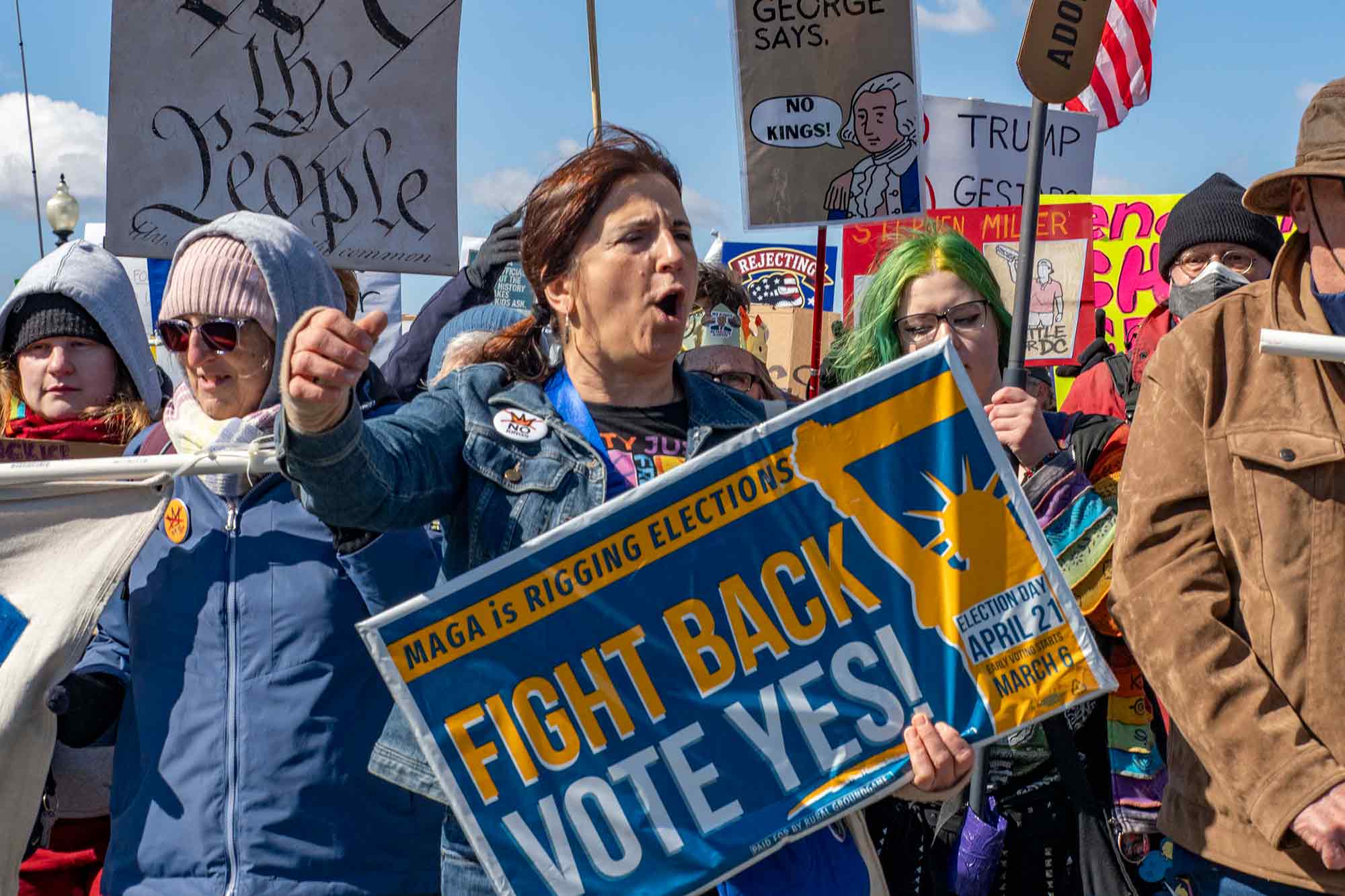
The decision was based on a procedural technicality. The special election held on April 21, which approved an amendment to the state constitution allowing mid-decade redistricting, was itself the product of two successive legislative sessions with an intervening election. The court ruled that because the initial legislative vote occurred after early voting had begun in the 2025 legislative elections, it did not meet the timing requirement, even though it occurred prior to Election Day.
In the special election that approved the change to the state constitution, over 3 million votes were cast, with “Yes” securing a majority, the winning margin being 3.4 percent (51.7 to 48.3). Nearly $100 million was spent on the election, including $83 million on the campaigns themselves.
The majority opinion does not formally reach the question of whether the challenged new map was “fair.” The map transformed a current 6–5 Democratic advantage into a likely 10–1 advantage, the former split being much closer to the overall statewide vote for the House. So, viewed in isolation, through a lens collimated to the Commonwealth of Virginia, the new map could make no pretense to being fair; it is a quintessential example of maximalist, precision gerrymandering for partisan advantage.
A Really Bad Decision, In or Out of Context
The US Supreme Court’s long-awaited decision in Louisiana v. Callais came down on April 29, gutting Section 2 of the Voting Rights Act (VRA) and effectively greenlighting the “cracking” and “packing” of majority-minority House districts (as well as state legislative and judicial districts) to dilute minority voting power and all but guarantee the replacement of Democratic representatives with Republicans.
Notably, and highly germane to our “big picture” analysis, SCOTUS’s Purcell principle — that courts should not intervene in election protocols and procedures, such as altering district boundaries, within the weeks or months before an election to prevent administrative chaos, voter confusion, and nonparticipation — has been consistently applied to overturn rulings favoring Democratic candidates.
Now, with GOP-favoring gerrymanders on the line, it’s “Purcell who?” for the SCOTUS right-wing majority, and for all courts, legislators, and executives pursuing pro-GOP outcomes. Put a pin in that.
Red states in the South, in which the VRA had protected minority voting power, instantly set about redrawing their maps (in most cases, the maps had already been drafted in anticipation of a favorable Callais ruling) to eliminate their minority-empowerment Democratic districts.
Louisiana canceled a primary election already in progress to ram through its new House map; Alabama got SCOTUS’s shadow-docket approval for its own new all-GOP map a week before its primary (did I hear someone say, “But Purcell…”?); Tennessee “cracked” its majority-minority district representing Memphis, and with it went the state’s sole Black and Democratic member of its US House delegation.
Relying on the Rucho Dissent
Although the Virginia majority, as noted above, hung its hat on a technical question of timing, the opinion, right up front in the introduction, gratuitously offers as context the view that partisan gerrymandering is a political evil that “undermines democracy.”
In a particularly rich twist, the opinion’s author, Justice D. Arthur Kelsey, cites and quotes Supreme Court Justice Elena Kagan’s opinion in Rucho v. Common Cause (2019):
“Partisan gerrymanders deprive citizens of the most fundamental of their constitutional rights: the rights to participate equally in the political process, to join with others to advance political beliefs, and to choose their political representatives.”
Of course, Justice Kagan was dissenting in Rucho, the case in which the high court’s 5–4 right-wing majority held that gerrymandering for partisan advantage was a “political question” outside the jurisdiction of federal courts.
As I’ve lamented in previous columns, the Rucho majority, via the pen of Chief Justice John Roberts, came to the dubious bordering on ludicrous conclusion that state legislative majorities could be counted on to restrain themselves from drawing maps designed to both lock in their own control and protect incumbents of both parties by making the vast majority of seats “safe” (i.e., noncompetitive). Hence Justice Kagan’s biting dissent.
Alito Finishes the Job
But Rucho did not go far enough to satisfy Roberts and today’s far-right supermajority. The Voting Rights Act — its powerful preclearance provisions of Section 5 having been gutted (5–4) in Shelby County v. Holder (2013) — still had some life left in Section 2, which had been amended in 1982 to make clear that gerrymandering that had a racially discriminatory effect was unlawful.
Nope, said Justice Sam Alito, writing for the proverbial 6–3 SCOTUS majority in Callais. We wouldn’t think of gutting what’s left of the VRA! We’ll just change the standard to discriminatory intent.
So if, for example, a legislature says, “We’re redrawing this map just to screw Black voters by making sure they’re moved into a bunch of white-majority districts where their votes will be safely diluted to uselessness,” well then you might just have a case!
If, however, the legislature draws the exact same map but says, “We’re doing this so Democratic voters will be diluted to uselessness,” too bad, so sad, you’re fresh out of luck!
(Pop quiz: Can you take a wild guess what the legislature will say?)
Because, you see, gerrymandering for partisan advantage (or to protect incumbents) isn’t just something we of the federal judiciary must keep our noses out of (see Rucho), it’s actually this really good thing that deserves our protection (see Callais)!
To wit, if a ruthless, maximalist, precision gerrymander happens to look blatantly racially discriminatory — exactly like the new maps that a bunch of red states in the South are now ginning up in a hurry look — the VRA is of no use to the disenfranchised because those maps were really drawn for partisan advantage, which is so cool that we’ll just have to tolerate the concomitant racial discrimination as a kind of negligible collateral damage. All this somehow or other rooted, according to Alito, somewhere in the 14th and 15th Amendments!
I hope I’ve made it clear, to lawyer and layperson alike, just how wilfully perverse Callais and the whole series of SCOTUS decisions dismembering the Voting Rights Act really are.
Racism and Politics Sittin’ in a Tree
It’s racism but — and here’s the real twist — it’s also politics. That is to say, these Republicans may or may not be racists hell bent on turning the clock back to Jim Crow or Dred Scott or the Three-Fifths Compromise, but they absolutely know that their path to “perpetual rule” runs through disenfranchising those who would vote against them — beginning with Blacks, of course, but also running through women (see the gender-targeted provisions of their precious SAVE America Act), students, urban residents, Americans abroad, et al.
The cruel irony of Callais is that at first blush the SCOTUS majority seem to be cloaking racism in political advantage, when they’re really cloaking political advantage in racism in political advantage.
When push comes to shove, their game is, first and foremost, political — that is, about power. Naturally, they’ll use that power for racist ends — but also to favor the rich, the corporations, the Christian nationalists, the gun lovers, the manosphere, and the despoilers of what’s left of the environment.
And to keep themselves in office — swinging pendulum be damned — so they can continue imposing these policies and the jurists they appoint can continue to ratify them.
The cruel irony of Callais is that at first blush the SCOTUS majority seem to be cloaking racism in political advantage, when they’re really cloaking political advantage in racism in political advantage. It brings to mind the structure of the double-helix, and that somehow fits because self-serving sophistry seems to be encoded in their judicial DNA.
Boldly Stomping Where the Courts Virtually Never Tread
Now back to the Virginia Supreme Court, which, as noted above, pointedly ignored Callais and Rucho (even citing the dissenting opinion from the latter) and took a dim view of gerrymandering for any purpose, including partisan advantage. That dim view, while not the legal basis for the court’s ruling, clearly informs it at just about every point.
Justice Kelsey, writing for the majority, duly celebrates the creation in 2020 by Virginia’s voters of the state’s independent redistricting commission; he notes the “wide margin” (65.7–34.3). And indeed, the voters of a number of other blue states, including California and New York, did the right thing around that time, setting up their own independent commissions, partly in response to Rucho’s 2019 green light to state legislatures to gerrymander to their partisan hearts’ content.
The amendment struck down by Scott did not pass by a wide margin (51.7–48.3; for what it’s worth, Trump, who insists his 2024 victory was a “landslide,” won the national vote 49.8–48.3, less than half the Virginia amendment’s margin).
But it did pass — under circumstances different enough from those of 2020 that hundreds of thousands of Virginia voters experienced a change of heart. (That is, by the way, very fundamentally, how elections in a democracy are supposed to work: Voters and circumstances change, so new elections supersede old ones.)
It is no secret what those circumstances are. Donald Trump launched a mid-decade redistricting war by leaning on the Texas GOP to redraw its already heavily red-gerrymandered map to find him the five more House seats to which he said he was “entitled” by virtue of having won the state in 2024. The Texas legislature of course complied and the new map is expected to produce a 30R–9D House delegation (30–9, incidentally, is a margin of 53.6 percent; Trump won Texas by 13.8 percent).
The Virginia vote to suspend its independent commission and allow the Democrat-controlled legislature to draw a new map came on April 21 as this war was playing out, and with the Callais decision pending.
Then, on April 29, came the Callais decision itself, in the wake of which more red states raced to impose their own new maps, with an expected GOP net gain of 7 to 12 more House seats, courtesy of the elimination of majority-minority districts previously protected under the now-comatose VRA.
The Virginia vote preceded Callais (it is safe to assume that if it had followed Callais, the margin of passage would have been significantly wider), but was obviously informed by the war raging nationally, a context of vital importance all but ignored in the Scott court’s majority opinion (though not by the dissent). Indeed, well-informed, since, as previously noted, the Yes and No campaigns together spent $83 million to make their cases.
As in California — the voters of which had earlier, in response to Trump’s Texas salvo, voted (64.4–35.6) to suspend its independent commission — but unlike in any of the red states, where there are no independent commissions so the legislatures were free to act without any voter input, it was the voters of Virginia who expressed their collective will, democratically.
The Scott majority nullified that election and that expression of the public will. That is a big, big deal — frowned upon throughout the long history of American jurisprudence, even more so than the supposed no-no of changing rules shortly before an election, and especially when the nullification rests on some technical or procedural flaw.
Yet the Virginia Supreme Court did so on indirect technical, procedural grounds — as if the timing of the first legislature’s vote to hold an election somehow cast doubt on the will of Virginia’s voters expressed in that election!
“No tenet of free government is more fundamental than fairness in voting and representation,” Justice Kelsey intoned, before going on to render a decision that twisted the knife in the back of “fairness in voting and representation” writ large across America.
The technicality could be, and was, argued: Did “before the election” mean “before early voting began” or “before Election Day”? It was, essentially, take your pick. The Scott majority found a little piece of judicial terra infirma to stand on and there they stood. This is, as I’ve noted before, what lawyers and judges do, to their eternal discredit.
But of course that was not what the Scott decision was really about, and I’d defy Justice Kelsey, or any member of the majority, to look me in the eye and tell me, with a straight face, that it was.
“No tenet of free government is more fundamental than fairness in voting and representation,” Justice Kelsey intoned, before going on to render a decision that twisted the knife in the back of “fairness in voting and representation” writ large across America.
What Can You Do in a Case Like That…?
Reaction to Scott has been swift, furious, and basically useless.
A proposal to effectively replace the Virginia Supreme Court by lowering the mandatory retirement age below that of the youngest of the justices in the majority, then have the new court rehear the case, went nowhere — judged, and probably rightfully so, as too nuclear even for a nuclear war.
An appeal to the US Supreme Court predictably was rejected.
Virginia Gov. Abigail Spanberger (D), who had already blown a good part of her political capital in support of the redistricting amendment, threw in the towel and said the state would use the old map in 2026. (One cannot help wondering whether a GOP governor — say a Tate Reeves [MS], Kay Ivey [AL], or Jeff Landry [LA] — would have gone so gentle.)
As Burl Ives once sang: “What can you do in a case like that? What can you do but sit on your hat, or your toothbrush, or your grandmother, or anything else that’s helpless?”
At best, Scott can be seen as an anti-gerrymandering decision made with blinders to the raging nationwide war for political control firmly affixed. At worst, it is, like Callais, just another cynical and rationalized promotion of the fortunes of Trump, MAGA, and the Republican way.
And so here we are: the electoral table for the House and a variety of state offices nice and tilted.
Analysts have concluded that for the Democrats to eke out a bare majority in the 2027 House, they will have to win the nationwide vote by a minimum of 4 percent, likely upwards of 4 million votes — quite a little handicap!
Add to the maximalist gerrymandering the other red thumbs on the scales…
- targeted voter purges;
- federal interference with voter registration;
- targeted hoops like proof of citizenship requirements, gun licenses but not student IDs accepted;
- ICE at the polls;
- Trump’s “election integrity posse”;
- concealed, computerized vote counting on equipment manufactured and programmed by ES&S and Liberty Vote, two outfits with strong right-wing affiliations;
- and the various in-the-works post-election challenge and nullification schemes…
… and you begin to see the scale of the asymmetrical warfare threatening not just the Democratic Party but our entire democracy.

Post a Comment for "Political Total War: How the US and Virginia Supreme Courts Shift the Electoral Balance"
Post a Comment