
Why experts urge 'stocks-maxxing' these US shares
The New Stock Market Wisdom
The old adage "sell in May and go away" has long been a part of stock market lore. However, this advice is no longer relevant in 2026. Instead, the current guidance from financial experts suggests that investors should be "stocks-maxxing" this month, meaning they should take advantage of the artificial intelligence (AI)-fueled upswing by snapping up US shares.
Several major financial institutions, including Bank of America, BlackRock, Citigroup, and the broking arm of HSBC, are favoring US stocks over their global counterparts. Despite rising hopes for a US-Iran peace accord, the trend of stocks-maxxing could be risky due to ongoing inflation and higher energy costs that threaten the US economy. However, it might also offer significant returns for those willing to take on substantial risk.
Lale Akoner, a global market analyst at brokers eToro, comments: "I still think the US remains the most compelling equity market globally – for selective exposure and risk management, not blind momentum chasing."
The Boom Loop
Bank of America strategist Michael Hartnett argues that the US economy is in a "boom loop," driven higher in dollar terms by surging corporate revenues, wage increases, government spending, and technology companies' massive investment in AI.
Forecasts for this expenditure have been revised upwards, with Morgan Stanley now expecting $800 billion this year, compared to its earlier estimate of $765 billion. Next year, the figure could reach $1.1 trillion, up from the previously predicted $950 billion. However, there is no guarantee of any payback from this spending spree.
These predictions have raised concerns among those who believe a downward spiral, or "doom loop," is the logical consequence of war in Iran and the overvaluation of tech shares. Yet, despite these concerns, the S&P 500 US stock market index hit a record high of 7,401 this week, as did the tech-heavy Nasdaq, which touched 26,218.

The Gung-Hos vs the Oh-Nos
The most recent US gross domestic product (GDP) report showed growth of 2 percent for the first quarter, slightly lower than the expected 2.2 percent. However, billionaire New York fund manager Bill Ackman, CEO of Pershing Square Management, believes AI spending will support the economy in the second half of this year.
Ackman also points to the One Big Beautiful Bill Act, a tax and welfare cut policy by President Donald Trump that raises investment in energy and other projects. His confidence is based on a relatively rapid resolution to the war, which he describes as a "weeks, but not many months phenomenon." After this, oil prices would begin to subside, lessening inflationary pressures.
Warren Buffett, the legendary founder of the $1 trillion Berkshire Hathaway fund, takes an opposite stance, observing that "prices for an awful lot of things will look very silly." Berkshire Hathaway has a $397 billion cash pile, but it does not seem inclined to invest in stocks-maxxing.
Those to Sell
The disconnect between the soaring performance of the indices and anxiety over the state of the economy may tempt some investors to "sell in May and go away," a practice followed in the 19th and 20th centuries in the US and the UK.
May, June, July, and August were traditionally times for socializing, not investing. In the US, some Wall Street types did not return to their desks until October. In Britain, share dealing resumed at the time of the St Leger horse race in September. The intervening period was spent at events like Ascot, Wimbledon, Henley Regatta, and Cowes. In the UK, selling in May sometimes makes sense. In 24 of the 50 years since 1976, there has been a summer correction in the MSCI UK index, according to a study from Bestinvest Evelyn.
However, as Jason Hollands of the finance firm adds, the market has not fallen during any summer this decade. Since 1976, the S&P 500 has declined in just 16 of the intervening years.
New Tech Names
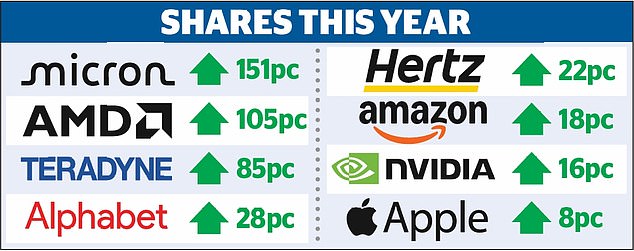
You may already be, unwittingly, stocks-maxxing in the US tech sector. Many global funds have stakes in the Magnificent Seven of tech—Alphabet, Amazon, Apple, Meta, Microsoft, Nvidia, and Tesla.
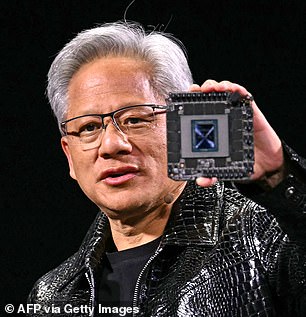
If you are attracted to this sector, look at less familiar companies playing a role in the AI revolution, such as microchip maker AMD, which is rated a "buy" at $445, a rival to the semiconductor behemoth Nvidia, run by Jensen Huang. Another is Teradyne, which tests microchips once manufactured. Its shares are considered a "buy" and were $363 yesterday.
There is also a focus on the firms that produce the memory elements of microchips. One key specialist is Micron. Its shares have soared by 757 percent over the past 12 months to $730, but are still considered a "buy."
Before committing, it's worth noting that, as Akoner puts it: "This is the point in the cycle where enthusiasm can run ahead of what can realistically be delivered. Investors should not confuse a transformational story with a guarantee every asset will deliver attractive returns."
But It's Not the Only Story...
Reorganizing the US part of your portfolio, rather than stocks-maxxing, may make sense if you have money in index funds that track the S&P and should give exposure to all sectors.
Tech stocks make up 35 percent of the S&P 500 and so constitute the same proportion of an index fund under the "weighting" rules of these vehicles. This would leave you vulnerable to a tech share sell-off.
"Equal weight" index funds are an alternative, as these hold the same amount of every constituent company and so provide greater downside protection. Hollands says: "Among options are the Legal & General S&P 500 US Equal Weight Index fund and the Shares S&P 500 Equal Weight Index exchange traded fund."
It could pay off to look beyond Silicon Valley as optimism spreads to other sectors. Hollands suggests the Dodge & Cox Worldwide US Stock fund, which has a range of holdings. Pershing Square Holdings, Ackman's FTSE 100 investment trust—one of my US picks—ventures into other industries. Its portfolio contains Alphabet, the Google group, but also Hertz and Dutch-American Universal Music—home to Taylor Swift and a firm for which Ackman is bidding. America's main business may be technology, but show business should not be forgotten.

Post a Comment for "Why experts urge 'stocks-maxxing' these US shares"
Post a Comment