
Why Did the Mitsubishi G4M "Betty" Catch Fire So Easily?
The Bomber That Looked Too Dangerous To Be Real
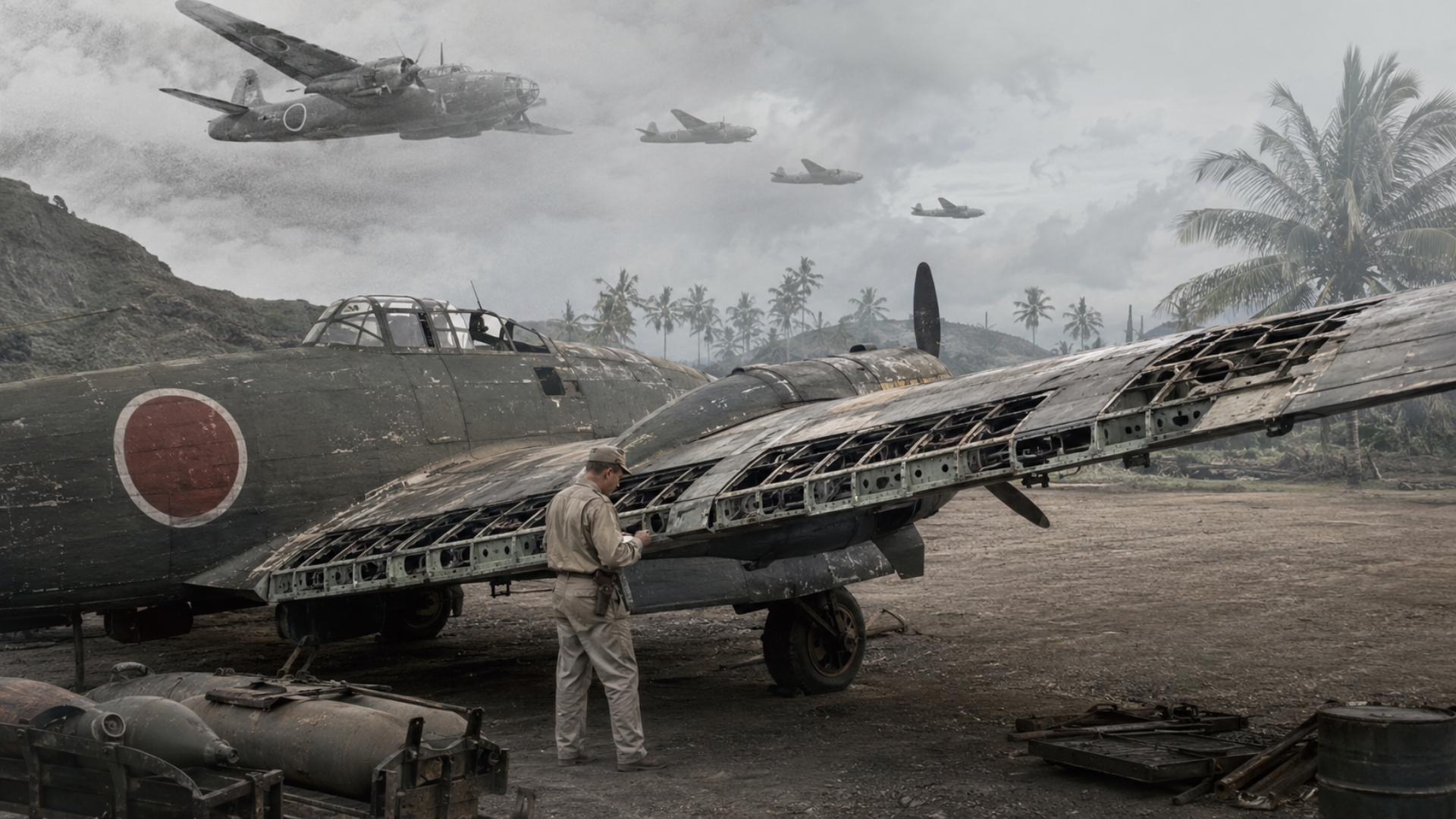
When Allied technicians examined intact Mitsubishi G4M bombers late in the Pacific War, they found something that seemed almost unbelievable. The aircraft’s long-range reputation was already known. Allied crews called it the “Betty.” It had struck targets hundreds of miles from Japanese bases, torpedoed warships, and helped Japan project air power across the Pacific in the war’s opening months.
But inside the wings was the price of that range. The G4M lacked armor protection and self-sealing fuel tanks in its early versions. The Smithsonian’s National Air and Space Museum describes the G4M as an aircraft whose long range came partly from weight savings, noting that against limited fighter opposition the absence of armor and self-sealing tanks was not initially a hindrance. That sentence contains the whole tragedy.
Against limited fighter opposition, the design worked. Against sustained fighter opposition, it burned.
At First, The Gamble Worked
In December 1941, the Betty looked like a strategic breakthrough. On December 8 in the Philippines, Japanese aircraft attacked Clark Field after the attack on Pearl Harbor. A summary of the raid lists Japanese strength at 108 bombers and 84 fighters, with U.S. losses including 12 B-17 bombers destroyed and many P-40 fighters lost. The strike was devastating because it exploited reach, altitude, timing, and American confusion. Japanese bombers came from bases on Formosa, far enough away that American commanders had not expected such a coordinated high-altitude blow to arrive so soon. Bombers hit airfields; Zero fighters followed with low-level strafing.
The Betty’s range had turned distance into surprise. At that point, its vulnerability was largely invisible. If defenders could not intercept the bombers in time, fuel-tank protection did not matter. If anti-aircraft fire could not reach them effectively, armor did not matter. The aircraft’s weakness existed. The Allies simply could not yet exploit it.
Force Z Proved Land-Based Air Power Could Kill Capital Ships
Two days later, the same design philosophy helped deliver an even greater shock. On December 10, 1941, Japanese aircraft attacked the British Force Z off Malaya. HMS Prince of Wales and HMS Repulse were underway at sea, maneuvering and defending themselves. Yet both were sunk by Japanese air attack. A summary of the action lists 88 Japanese aircraft involved, including torpedo aircraft and level bombers, and British losses at one battleship, one battlecruiser, and about 840 men killed.
The sinking of Prince of Wales and Repulse transformed naval thinking. Capital ships operating without air cover could be destroyed by land-based aircraft. The age of the battleship as an independent instrument of sea control had effectively ended. The Betty was central to that lesson because it could carry torpedoes over long distances and coordinate with other Japanese aircraft in complex attacks.
In December 1941, Allied officers were not laughing at the G4M. They were trying to understand how Japan could reach so far and strike so hard.
Range Was Not Armor
The Betty’s early success depended on a specific battlefield environment. Japanese pilots were experienced. Allied fighter defenses were weak or disorganized. Japanese bases were positioned to exploit distance. The aircraft could often reach targets, attack, and withdraw before defenders responded effectively. That made range feel like protection. But range is not armor.
As American and Allied airfields moved closer to Japanese operating areas, and as fighter interception improved, the Betty’s design entered a different war. The aircraft was still fast and long-ranged, but now enemy fighters could reach it before, during, or after attacks. Once that happened, the missing protection became catastrophic. A few machine-gun or cannon hits near the wing tanks could ignite fuel vapor. Fires spread quickly. Many crews had little chance to recover.
Allied pilots gave the aircraft bitter nicknames, including “flying lighter,” “one-shot lighter,” “flying Zippo,” and “flying cigar.” Those nicknames reflected combat experience: the aircraft tended to catch fire when hit in the fuel tanks.
Guadalcanal Exposed The Flaw
Guadalcanal was the turning point. From Rabaul, Betty bombers could reach the Solomon Islands and attack American positions at long range. In the early war, that reach would have been a major advantage. Over Guadalcanal, it became a route into fighter interception. The uploaded account describes an August 1942 mission in which a large portion of a Betty formation was shot down near Guadalcanal, emphasizing how quickly the aircraft’s reputation changed once Wildcats and improved defenses could meet it in force.
The broader pattern is historically clear even where exact mission figures vary by account. The Solomons campaign forced G4M crews to fly long, dangerous missions into increasingly defended airspace. Losses mounted. Aircraft that had once seemed untouchable became vulnerable targets. The Betty had been optimized for the war Japan expected to fight. Guadalcanal forced it into the war Japan actually faced.
Allied Engineers Found A Philosophy In The Wreckage
When Allied technical teams examined captured or abandoned G4Ms, they were not just studying an aircraft. They were studying a worldview. American and British aircraft design increasingly emphasized crew protection, self-sealing tanks, armor around critical areas, redundancy, and survivability. These features added weight, reduced some performance, and complicated production. But they made it more likely that trained crews could bring damaged aircraft home.
The G4M’s early design made the opposite choice. It accepted that if the aircraft was hit, survival was unlikely. That decision was not irrational in the context of Japanese strategic assumptions. Japan needed long-range strike aircraft to compensate for distance and limited base networks. It expected short, decisive campaigns. It did not expect a long attritional air war against a United States that could expand fighter coverage, replace aircraft, and train pilots in enormous numbers.
That is why the Betty’s unprotected tanks mattered so much. They were not merely a technical flaw. They were evidence of strategic optimism.
Capability Without Survivability Has A Deadline
The G4M Betty is a lesson in military design. Every weapon is a compromise. Range, speed, payload, armor, fuel, reliability, and production all compete with one another. No aircraft can maximize everything. The danger comes when one requirement becomes so dominant that the weapon cannot survive the conditions it is likely to face.
The Betty’s range was real. So was its vulnerability. In 1941, the range mattered more. By 1943, the vulnerability mattered more. By 1945, the vulnerability had become the aircraft’s defining feature. That is why the Betty’s story still matters. It shows how a successful design can become a strategic trap when the assumptions behind it collapse.
Japan built a bomber that could reach almost anywhere. But once the enemy could reach back, there was almost nothing inside its wings to keep its crews alive.

Post a Comment for "Why Did the Mitsubishi G4M "Betty" Catch Fire So Easily?"
Post a Comment