
The secret trigger that turned near misses into kills
The Shell That Did Not Need To Hit
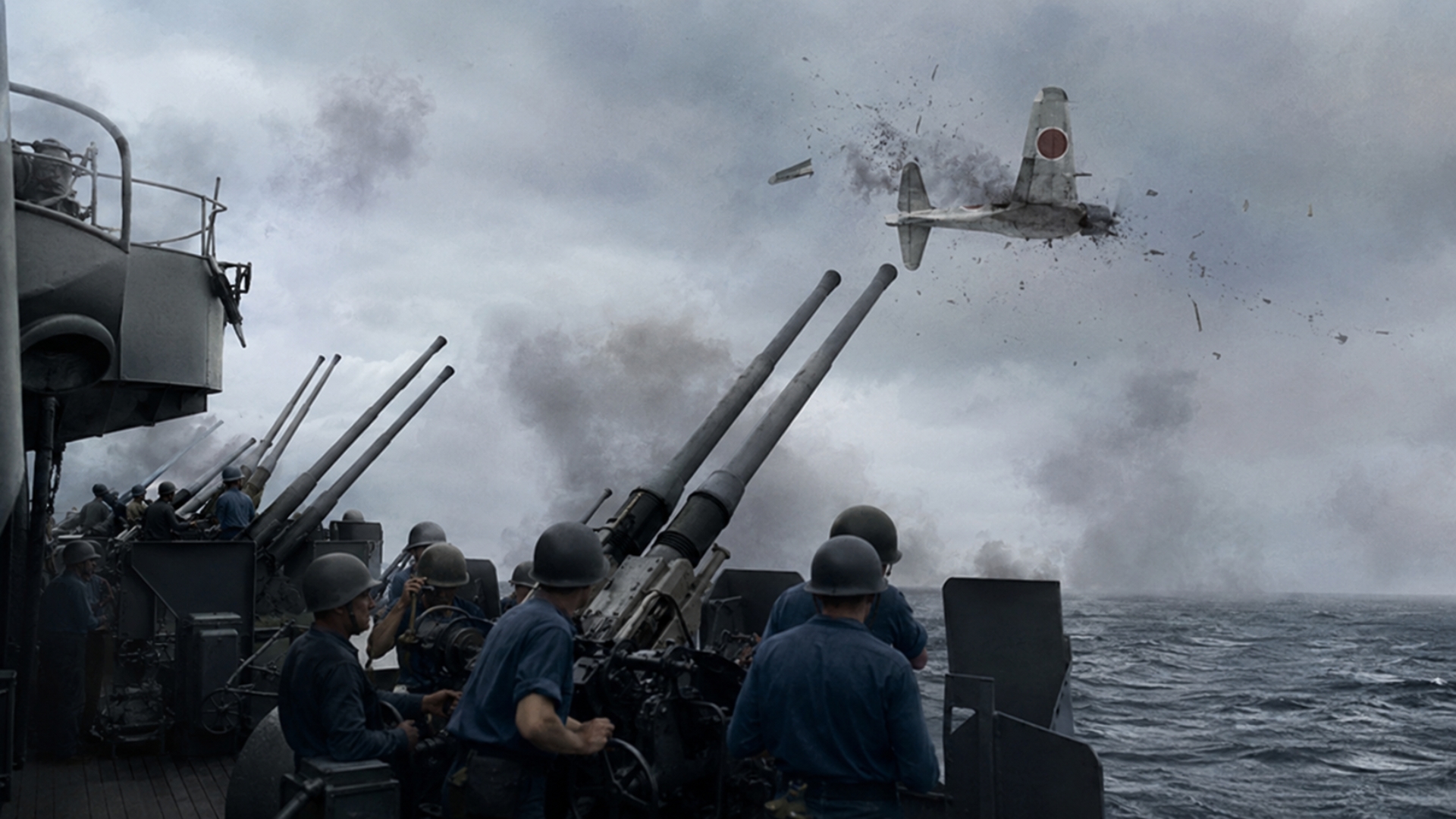
On January 5, 1943, off Guadalcanal, the light cruiser USS Helena fired at a Japanese dive bomber that was already pulling away. Under ordinary rules, the shot should not have mattered. The target was distant, moving fast, and escaping. Anti-aircraft fire in that era usually required a direct hit or a precisely timed explosion. A shell that passed near an aircraft was normally a failure.
But Helena’s shell did something different. It exploded close enough to destroy the aircraft without striking it. Naval Sea Systems Command’s Dahlgren history states that on January 5, 1943, Helena’s aft five-inch battery shot down a Japanese dive bomber with VT-fuzed shells near Guadalcanal, marking the combat debut of the radio proximity fuse. That small moment changed anti-aircraft warfare.
The projectile had carried a tiny radio device inside its nose. It sensed when it was near the target and detonated automatically. A near miss became a kill.
The Old Mathematics Were Brutal
Before the proximity fuse, anti-aircraft gunnery was a contest against probability. A gun crew had to estimate a target’s altitude, speed, direction, and future position, then fire a shell that would either hit directly or explode at exactly the right moment. Contact fuses required a physical strike. Time fuses required accurate timing under combat conditions.
Both systems were unforgiving. If the shell exploded a fraction of a second too early or too late, it missed. If it failed to explode in the air, it could fall back to earth and detonate among civilians or friendly forces.
Pearl Harbor exposed the danger. The National Park Service notes that many five-inch anti-aircraft rounds fired during the December 7, 1941 attack failed to detonate properly in the air and fell into civilian areas around Pearl Harbor and Honolulu. Civilian death records from the attack list 49 civilians killed, and later accounts note that 32 died in Honolulu, many from American anti-aircraft rounds that landed in residential districts.
The problem was not lack of courage by gun crews. It was physics. They were trying to hit fast aircraft with shells that offered almost no margin for error.
The First Tests Changed The Navy’s Expectations
Once the fuse began working, tests quickly proved its value. The U.S. Naval Institute’s history of the proximity fuse describes Helena’s January 1943 combat success and notes that the National Defense Research Committee had achieved in roughly 30 months what had first appeared impossible. Other summaries of the program note that the first accepted production fuses came off the line in September 1942 and that Helena’s January 1943 success confirmed the weapon in combat.
The Navy now had a shell that did not need perfect timing from a human gun crew. It only needed to pass close. That changed the defensive equation for ships facing dive bombers, torpedo bombers, and later kamikaze aircraft.
The Weapon Was Kept Almost As Secret As The Atomic Bomb
The proximity fuse was one of the most closely guarded Allied technologies of World War II. The fear was simple: if a dud shell landed where the enemy could recover it, Germany or Japan might reverse engineer the device. For that reason, early use was restricted mainly to naval combat over water, where unexploded shells would sink.
The secrecy extended into production. Many workers built components without knowing what the final weapon was. Different companies produced parts in isolation. The uploaded account notes that companies such as Crosley, RCA, General Electric, and Eastman Kodak participated in the enormous industrial effort, with thousands of workers assembling delicate parts under strict secrecy.
This was an American advantage the Axis powers struggled to match. The fuse required physics, electronics, manufacturing discipline, quality control, and industrial scale. It was not enough to understand the idea. A nation had to build millions of reliable miniature devices and deliver them to the front. The United States could.
The People Behind It Faded From View
After the war, the proximity fuse was finally revealed to the public. The uploaded source states that American industry produced more than 22 million proximity fuses by war’s end and that the cost per unit collapsed as mass production improved. Yet the people behind the weapon did not become household names.
Merle Tuve returned to scientific work. James Van Allen became famous later for space science. The thousands of workers—many of them women—who assembled microscopic components received far less recognition. Many had not known exactly what they were building until after secrecy was lifted.
That anonymity is typical of technological warfare. The most decisive weapons are often built by people far from the battlefield, working on components no one around them fully understands.
The Fuse Foreshadowed Modern Smart Weapons
The proximity fuse belongs to a larger history of weapons that sense their environment. It was not a guided missile. It did not steer itself. It did not identify targets visually. But it did something revolutionary for its time: it made a munition responsive. It detected proximity and acted at the correct moment.
That principle echoes through later military technology: radar-guided missiles, air-defense interceptors, sensor-fused weapons, and modern munitions designed to detonate at optimal distance rather than on simple impact. The proximity fuse was one of the first mass-produced examples of that logic. It made the weapon aware enough to change the outcome.

Post a Comment for "The secret trigger that turned near misses into kills"
Post a Comment