
The P-51 Mustang Defied Oblivion After WWII
The Fighter That Outlived Its Own War
The P-51 Mustang was built for a very specific emergency: escorting Allied bombers deep into enemy territory and bringing them home. By 1944, it had become one of the most important fighters in the U.S. Army Air Forces, prized for its range, speed, and high-altitude performance. The National Museum of the U.S. Air Force describes it as a long-range escort fighter that also served as a fighter-bomber and later fought in Korea.
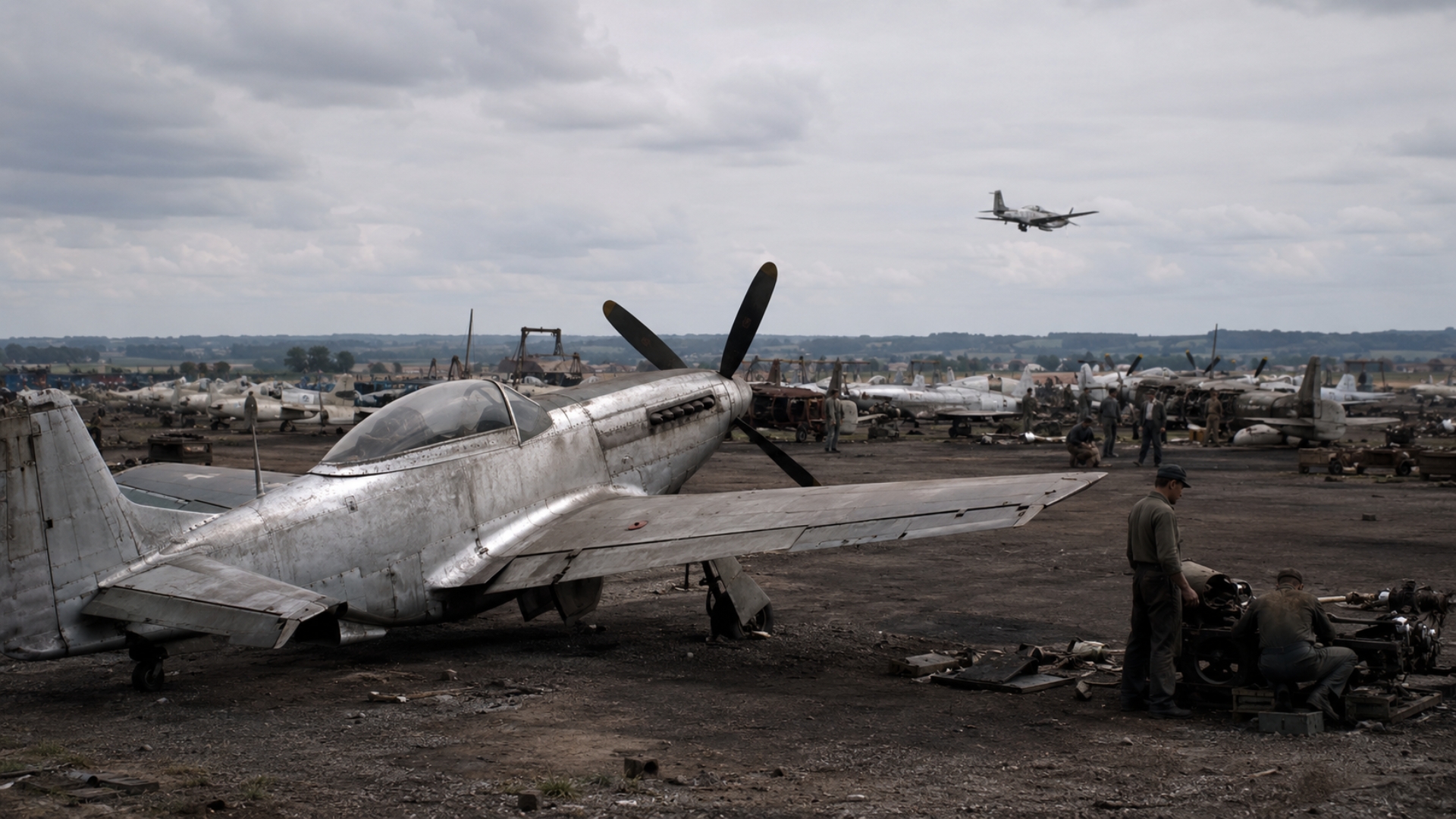
By every normal measure, its story should have ended soon after 1945. Jets were arriving. Wartime budgets were shrinking. Airfields were full of aircraft nobody wanted to maintain. North American’s Mustang production ended after more than 15,000 aircraft of all types had been built, leaving the postwar world with far more propeller fighters than it needed.
But the Mustang did not disappear. It was sold, stored, modified, raced, smuggled, adapted, and restored. Its postwar life became a strange second career—less famous than its wartime service, but in some ways more revealing.
Peace Turned Victory Machines Into Surplus
The Mustang’s first enemy after World War II was not another aircraft. It was irrelevance.
Thousands of fighters that had once represented industrial urgency were suddenly expensive leftovers. Governments no longer needed vast fleets of piston-engine escorts. Scrap dealers saw aluminum. Small air forces saw opportunity. Pilots saw speed.
This was the central contradiction of the Mustang’s second life. The same aircraft that had helped defeat Nazi Germany could now be bought, stripped, modified, and repurposed by people who had very different needs. In the United States, that often meant air racing. Abroad, it meant national defense.
The Mustang’s technical strengths mattered after the war because they were practical. It could fly long distances, carry weapons, operate from relatively basic airfields, and be maintained by crews who understood piston engines. In a world rushing toward jets, that made it old-fashioned. In a crisis, it made it useful.
Cleveland Showed The Danger Of Turning Warplanes Into Racers
One of the Mustang’s most dramatic postwar chapters came not in combat, but at the Cleveland National Air Races.
On September 5, 1949, Bill Odom flew a radically modified P-51C called Beguine in the Thompson Trophy Race. The aircraft had been altered heavily for speed, including changes to its cooling system and fuselage. Odom had qualified at more than 405 mph, but during the race the aircraft rolled inverted and crashed into a house in Berea, Ohio. Odom was killed, along with Jeanne Laird and her infant son, Craig.
The crash exposed a hard truth about postwar air racing. Military aircraft could be made faster, but not safely in every circumstance. Fighters designed for combat were being pushed around low-altitude pylon courses with engines and airframes modified beyond their original purpose.
The Mustang survived air racing, but not innocently. Its speed made it attractive. Its limits made it dangerous.
Korea Proved Jets Were Not Always The Answer
The Korean War gave the Mustang its most important combat role after World War II.
When North Korean forces invaded South Korea on June 25, 1950, the jet age had already begun. Yet early jet fighters faced serious limitations over Korea. They consumed fuel quickly, needed better runways, and could not always remain over the battlefield long enough to support troops in trouble.
The Mustang, redesignated F-51 in U.S. Air Force service, was not ideal for Korea, but it was available and useful. The U.S. Air Force quickly supplied F-51s to help build the fledgling South Korean air force under the “Bout One” program, and F-51 pilots carried out combat flights while training South Korean aviators.
The aircraft also reached the theater in large numbers by sea. In July 1950, the carrier USS Boxer was pressed into service as an aircraft ferry, carrying 145 Air Force F-51s across the Pacific for the Korean emergency.
In Korea, the Mustang’s strengths and weaknesses appeared together. It could loiter, strike roads and bridges, and support troops at low altitude. But its liquid-cooled Merlin engine was vulnerable to ground fire. A single hit to the cooling system could doom the aircraft. The Mustang was no longer dueling fighters above Europe. It was flying into rifle, machine-gun, and anti-aircraft fire at low level.
That was not the war it had been designed for. It was the war that needed it.
Small Air Forces Saw What Great Powers Discarded
The Mustang also became valuable to nations that could not afford large jet fleets.
Israel acquired P-51Ds during its early years, when its air force was being built under severe pressure and often through improvised procurement. The Israeli Air Force later used Mustangs in the 1956 Suez Crisis, including a famous low-level mission to sever Egyptian telephone lines in the Sinai. An Israeli Air Force historical page notes that the squadron later carried out the opening operation of the Suez Crisis by cutting phone lines connecting Sinai with Egypt.
The details of that mission have often been retold because they sound almost unbelievable: Mustangs used at extreme low level not merely to bomb or strafe, but to physically cut communications. Whether remembered as daring, reckless, or both, the mission captured the essence of the Mustang’s postwar role. It survived because pilots and commanders kept finding new uses for it.
The Last Piston Dogfights Came Long After World War II
The Mustang’s combat afterlife stretched into Central America.
In July 1969, Honduras and El Salvador fought the brief conflict commonly called the Football War, though its causes were rooted in deeper disputes over land, migration, and politics. Smithsonian Magazine notes that the last dogfights between piston-engine, propeller-driven aircraft occurred in that conflict, with U.S.-built Corsairs and Mustangs in the air.
The final image was not a Mustang triumph over a jet, but something more historically strange: World War II-era aircraft fighting each other in the late 1960s. Honduran pilot Fernando Soto shot down Salvadoran aircraft, including a Mustang, in what became part of the final chapter of propeller-driven fighter combat.
The Mustang had begun as a cutting-edge solution to the bomber escort problem. It ended its combat life as a relic still dangerous enough to matter.
The Mustang Survived Because It Remained Useful
The P-51 Mustang’s postwar story is not simply about a famous aircraft lasting longer than expected. It is about how military technology changes meaning after the war that created it.
In World War II, the Mustang was a strategic escort fighter. In Korea, it became a low-level attacker. In Israel, it became an improvised tool of survival and surprise. In Central America, it became part of the last era of piston fighter combat. In air racing, it became a dangerous test of speed. In museums and airshows, it became a witness.
That is why the Mustang’s second life matters. It shows that obsolescence is not always the same as uselessness. Jets made the Mustang old, but they did not immediately make it irrelevant.
The aircraft survived because it could be adapted. It endured because people kept finding reasons to fly it, repair it, race it, and save it.
Long after the war it was built for, the Mustang remained in the air—not because history forgot to end its story, but because the aircraft still had something to say.

Post a Comment for "The P-51 Mustang Defied Oblivion After WWII"
Post a Comment