
The Jeep That Showcased American Industry to Germany
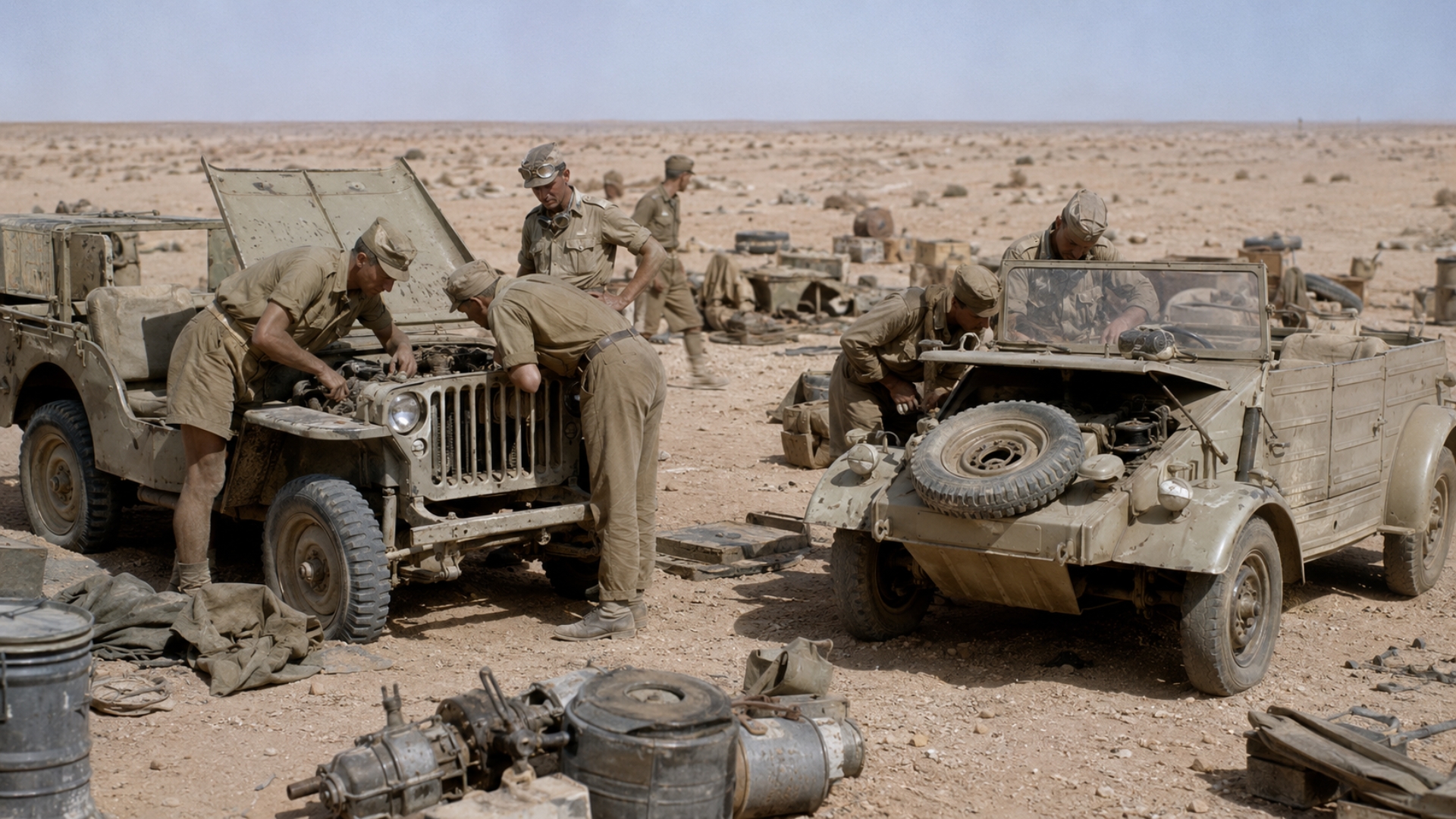
The Vehicle That Looked Too Crude To Matter
At first glance, the American Jeep did not look like a weapon that could unsettle German confidence. It was boxy, plain, and almost aggressively simple. Its flat panels had little elegance. Its controls were basic. Its engine was modest. Nothing about it suggested the mechanical refinement that German engineers often prized.
But that was the mistake.
The Willys MB and Ford GPW were not designed to impress engineers. They were designed to move soldiers, weapons, radios, ammunition, officers, medics, and supplies across bad terrain with minimal fuss. They were designed to be repaired quickly, by ordinary soldiers, under conditions no factory engineer could control.
That made the Jeep dangerous in a way that was not immediately obvious.
German vehicles often reflected precision. The Jeep reflected use.
And in a long war, use mattered more.
German Comparison Made The Difference Clear
Germany had its own famous light military vehicle: the Volkswagen Kübelwagen.
The Kübelwagen was an effective design in many respects. It was light, fuel-efficient, mechanically clever, and well suited to many Wehrmacht needs. It used an air-cooled rear engine and was simpler than many German military vehicles. Roughly 50,435 Type 82 Kübelwagens were produced during the war.
But the Kübelwagen was not a direct equivalent to the Jeep.
It was rear-wheel drive. The Jeep was four-wheel drive. The Kübelwagen was lighter and efficient; the Jeep was heavier, stronger, and more adaptable. In easy going, the German vehicle could perform well. In difficult ground, the Jeep’s traction and ruggedness gave it a different kind of advantage.
That difference mattered in places like North Africa, Italy, France, and the Ardennes.
The Jeep was not the more refined answer.
It was the more forgiving one.
Simplicity Was Not Inferiority
German observers could easily mistake simplicity for backwardness.
That was understandable. German engineering culture valued precision, efficiency, and carefully designed mechanical solutions. A vehicle that looked plain and overbuilt could seem crude by comparison.
But the Jeep’s simplicity was deliberate.
A vehicle at the front is not judged by elegance. It is judged by whether it starts, whether it moves, whether it can be fixed, and whether it can return to service quickly after damage.
The uploaded account captures this contrast well: the Jeep’s engine bay, standardized parts, four-wheel-drive system, and repair-friendly layout revealed a different philosophy—one built not around perfection, but around battlefield reality.
That was the quiet lesson.
The Americans were not building vehicles for ideal drivers, ideal roads, or ideal mechanics. They were building them for tired soldiers in bad conditions with limited tools.
Interchangeability Was A Weapon
The Jeep’s power came partly from interchangeability.
Willys and Ford produced broadly standardized vehicles whose components could be swapped across production lines. A Ford GPW and a Willys MB were not identical in every marking or detail, but they were built to the same Army standard and shared practical parts compatibility. Wartime Jeep histories emphasize that Willys and Ford together produced nearly 650,000 quarter-ton 4x4s, with Ford building roughly 280,000 and Willys more than 350,000.
That mattered because repairs at the front are not about perfection.
They are about time.
A broken vehicle can be repaired if the part exists, fits, and can be installed without specialist tools. If parts vary too much, repairs slow down. If vehicles require highly trained mechanics, the supply chain becomes fragile. If one damaged component immobilizes a vehicle for days, the tactical value of the machine collapses.
The Jeep’s standardization turned maintenance into a battlefield advantage.
One vehicle could keep another alive.
Production Changed The Meaning Of Loss
Germany could build excellent machines.
The United States built enough machines.
That distinction shaped the war.
The Jeep was produced in numbers that dwarfed the Kübelwagen. More than 640,000 wartime Jeeps were built, compared with about 50,000 wartime Kübelwagens.
This did not mean every Jeep was better in every technical category. It meant the Americans could absorb loss differently.
If a Jeep broke, another could replace it. If one was damaged, parts were available. If a unit needed more vehicles, more could be delivered. That abundance changed behavior. American units could use vehicles aggressively, risk them, overload them, and keep moving.
German units often could not.
Scarcity shapes tactics. When every vehicle is difficult to replace, commanders become cautious. When every repair depends on scarce parts, movement slows. When a truck loss creates a gap that cannot be filled, logistics become brittle.
The Jeep represented the opposite condition.
It made movement routine.
The Jeep Was Part Of A Larger American System
The Jeep alone did not explain American logistics.
It belonged to a larger system of trucks, depots, fuel supplies, spare parts, shipping, maintenance units, manuals, mechanics, and industrial production. The United States did not merely field a useful light vehicle. It built an entire supply culture around keeping vehicles moving.
This was the same industrial logic that produced Liberty ships, B-24 bombers, trucks, tanks, radios, landing craft, and ammunition at extraordinary scale. The Jeep was simply one of the clearest examples because it was everywhere.
Senior Allied leaders recognized its importance. The Jeep’s reputation became so large that Dwight Eisenhower later listed it among the key pieces of equipment that helped win the war, and George Marshall called it one of America’s greatest contributions to modern warfare.

Post a Comment for "The Jeep That Showcased American Industry to Germany"
Post a Comment