
The Admiral Who Knew Japan Could Not Outlast America
The Warning Japan Chose Not to Hear
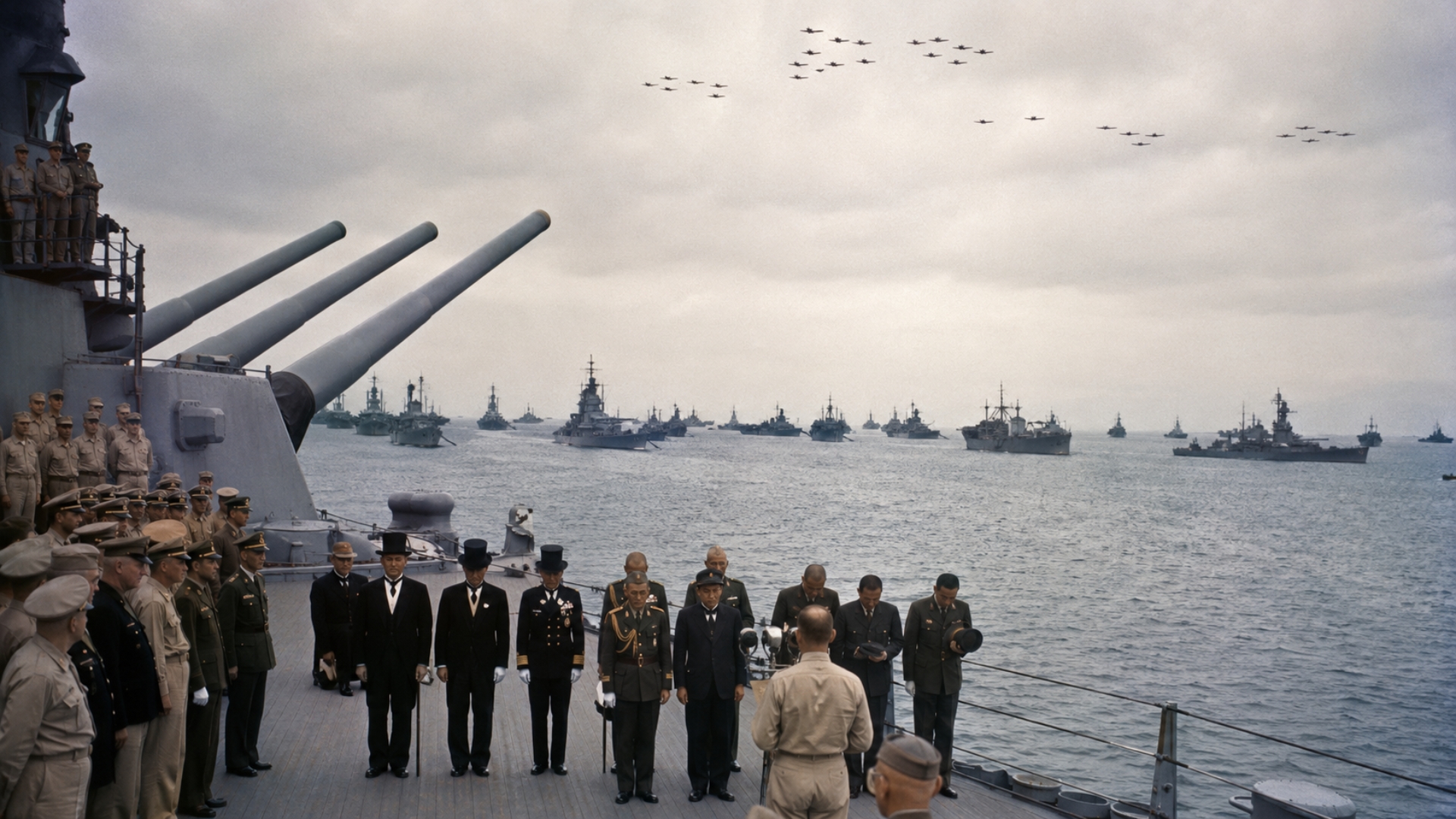
On September 2, 1945, Japanese representatives stood aboard the battleship USS Missouri in Tokyo Bay and signed the surrender documents that formally ended World War II. Around them was the physical evidence of defeat. Allied warships filled the bay. Aircraft passed overhead in formation. The ceremony was brief, but the setting said more than the signatures ever could.
Japan was not merely surrendering to a victorious navy. It was surrendering to a nation that had turned its industry, resources, shipyards, aircraft plants, training programs, and supply networks into a war machine of overwhelming scale.
Admiral Isoroku Yamamoto had understood that danger long before Pearl Harbor. Yamamoto, the commander who helped plan Japan’s opening strike against the United States, never believed Japan could win a long war against America. He did not doubt Japanese courage. He did not doubt Japanese skill. He doubted Japan’s ability to outproduce, outfuel, and outlast an industrial giant.
That was the warning many of Japan’s wartime leaders chose not to hear.
Yamamoto Understood America Because He Had Lived There
Yamamoto’s view of the United States was shaped by direct experience. After World War I, he studied at Harvard. Later, from 1926 to 1928, he served as Japan’s naval attaché in Washington. Those years gave him a clearer understanding of American power than many officers in Tokyo possessed.
He saw a country with enormous reserves of fuel, steel, money, transportation, food, and technical skill. He saw factories that could be adapted for war. He saw oil fields that made Japan’s dependence on imported fuel look dangerous. He saw a society that was not exhausted by scarcity in the way Japan often was.
That experience made him realistic. Japan had a formidable navy. Its pilots were highly trained. Its officers were aggressive, disciplined, and experienced. But Japan lacked America’s depth. It could train excellent airmen, but it could not replace them easily. It could build advanced ships, but not at the speed the United States could once fully mobilized.
To Yamamoto, this was not a matter of national spirit. It was arithmetic.
Japan might win battles. It might dominate the opening phase of a Pacific war. But if the conflict became prolonged, the balance would turn against it with brutal certainty.
The Famous Prediction Was a Warning, Not a Boast
Yamamoto is often remembered for a warning that he could “run wild” for six months to a year, but had no confidence after that. The exact wording has been repeated in different forms, but the meaning fits his strategic view clearly.
Japan’s only chance was a short war. That was the heart of his concern. Japan’s military leadership hoped that a sudden blow would shock the United States into negotiation. Yamamoto understood the danger in that assumption. The United States did not have to win immediately. It only had to stay in the war long enough for its factories, shipyards, oil fields, and training programs to take effect.
Every month would matter. Every ship America lost could be replaced. Every aircraft destroyed could be rebuilt. Every pilot killed could be followed by another trained through a vast national system. Japan, by contrast, had far less room for attrition.
Yamamoto was not saying Japan could not fight well. He was saying Japan could not fight endlessly.
Pearl Harbor Bought Time, but Awakened the Wrong Enemy
When Japan chose war, Yamamoto obeyed. As commander in chief of the Combined Fleet, he helped plan the attack on Pearl Harbor. On December 7, 1941, Japanese carrier aircraft struck the U.S. Pacific Fleet in Hawaii. The attack was sudden, coordinated, and devastating. Battleships burned. Aircraft were destroyed on the ground. Thousands of Americans were killed or wounded.
From a tactical standpoint, the attack was a major Japanese success. But it was incomplete. The American aircraft carriers were not in port. They were at sea. That mattered because the future of the Pacific War would be decided not by battleships alone, but by carrier aviation, naval airpower, and the ability to replace losses.
Pearl Harbor also produced the political effect Yamamoto had feared. Instead of shattering American morale, it unified the United States. Isolationist sentiment collapsed. Congress declared war. Factories shifted to military production. Shipyards expanded. Training programs multiplied.
Japan had gained the opening initiative. It had also awakened the industrial power Yamamoto believed Japan could not survive.
The Early Victories Hid the Deeper Danger
For several months after Pearl Harbor, Japan appeared unstoppable. Its forces advanced across Southeast Asia and the Pacific with astonishing speed. The Philippines fell after bitter fighting. Singapore, long considered a British imperial fortress, surrendered. The Dutch East Indies brought Japan access to desperately needed oil resources. Japanese power spread across a vast perimeter of islands, sea lanes, airfields, and captured territories.
To many in Tokyo, the early victories seemed to confirm that the gamble had worked. But Yamamoto understood the hidden cost. Every new conquest had to be defended. Every island garrison needed food, fuel, ammunition, medical supplies, aircraft, mechanics, and shipping. Every mile of expansion stretched Japan’s already limited logistics farther across the ocean.
What looked like momentum also created vulnerability. Japan’s merchant fleet was limited. Its industry struggled to replace losses. Its supply lines were exposed. Its oil problem had not been solved so much as moved onto a larger and more fragile map.
Meanwhile, the United States was mobilizing on a scale Japan could not match. Aircraft production surged. New ships were laid down. Training fields spread across the country. American losses were painful, but the system was built to absorb them.
Japan was still winning battles. But the war was beginning to move into the kind of contest Yamamoto had warned about.
Midway Ended the Illusion of Unlimited Japanese Momentum
The Battle of Midway came in June 1942, almost exactly six months after Pearl Harbor. For Japan, the plan was to draw out and destroy America’s remaining carriers. Midway Atoll would serve as bait. The Japanese carrier force, still feared and experienced, would crush the U.S. Navy in a decisive engagement.
But the Americans were no longer blind. U.S. codebreakers had identified Midway as the target, allowing American commanders to prepare. The carrier USS Yorktown, badly damaged at the Battle of the Coral Sea, was repaired quickly enough to return to combat, a sign of the urgency and repair capacity Yamamoto knew America possessed.
On June 4, 1942, American dive bombers found the Japanese carriers at a devastating moment. Aircraft were being fueled and armed. Hangar decks were vulnerable. In minutes, Akagi, Kaga, and Soryu were mortally wounded. Later, Hiryu was also destroyed.
Japan lost four fleet carriers and many veteran airmen and deck crews. The defeat did not end the Pacific War, but it permanently changed its direction. Japan had lost the core of the carrier striking force it had spent years building. It could not easily replace the ships. It could replace the experienced men even less easily.
Midway fulfilled the logic of Yamamoto’s warning. Japan’s opening advantage had been real. It was also temporary.
The Surrender Made Yamamoto’s Arithmetic Visible
In August 1945, atomic bombs destroyed Hiroshima and Nagasaki. The Soviet Union entered the war against Japan. Japan’s leaders faced a reality that could no longer be avoided. Continued resistance meant national ruin. Emperor Hirohito intervened and accepted surrender. On September 2, 1945, Japanese representatives boarded USS Missouri in Tokyo Bay and signed the formal documents.
Yamamoto did not live to see that moment. He had been killed in April 1943 when American fighters intercepted his aircraft over the Solomon Islands. But the scene in Tokyo Bay confirmed the logic he had understood years earlier.
The United States had not merely defeated Japan in a series of battles. It had overwhelmed Japan through production, fuel, shipping, training, repair capacity, and industrial endurance. It had replaced losses Japan could not replace. It had expanded while Japan contracted. It had turned time into an ally.
Japan had fought with discipline, skill, and sacrifice. But it had chosen a war against a country it could not exhaust, occupy, or outbuild.
That was Yamamoto’s warning. On the deck of the Missouri, surrounded by ships, aircraft, and the quiet machinery of victory, the warning finally stood complete.
Japan had not lost because it lacked bravery. It had lost because it had challenged a scale of power it could never sustain.

Post a Comment for "The Admiral Who Knew Japan Could Not Outlast America"
Post a Comment