
How German POWs Reacted to America's Hidden Truth
The Arrival That Did Not Match the Propaganda
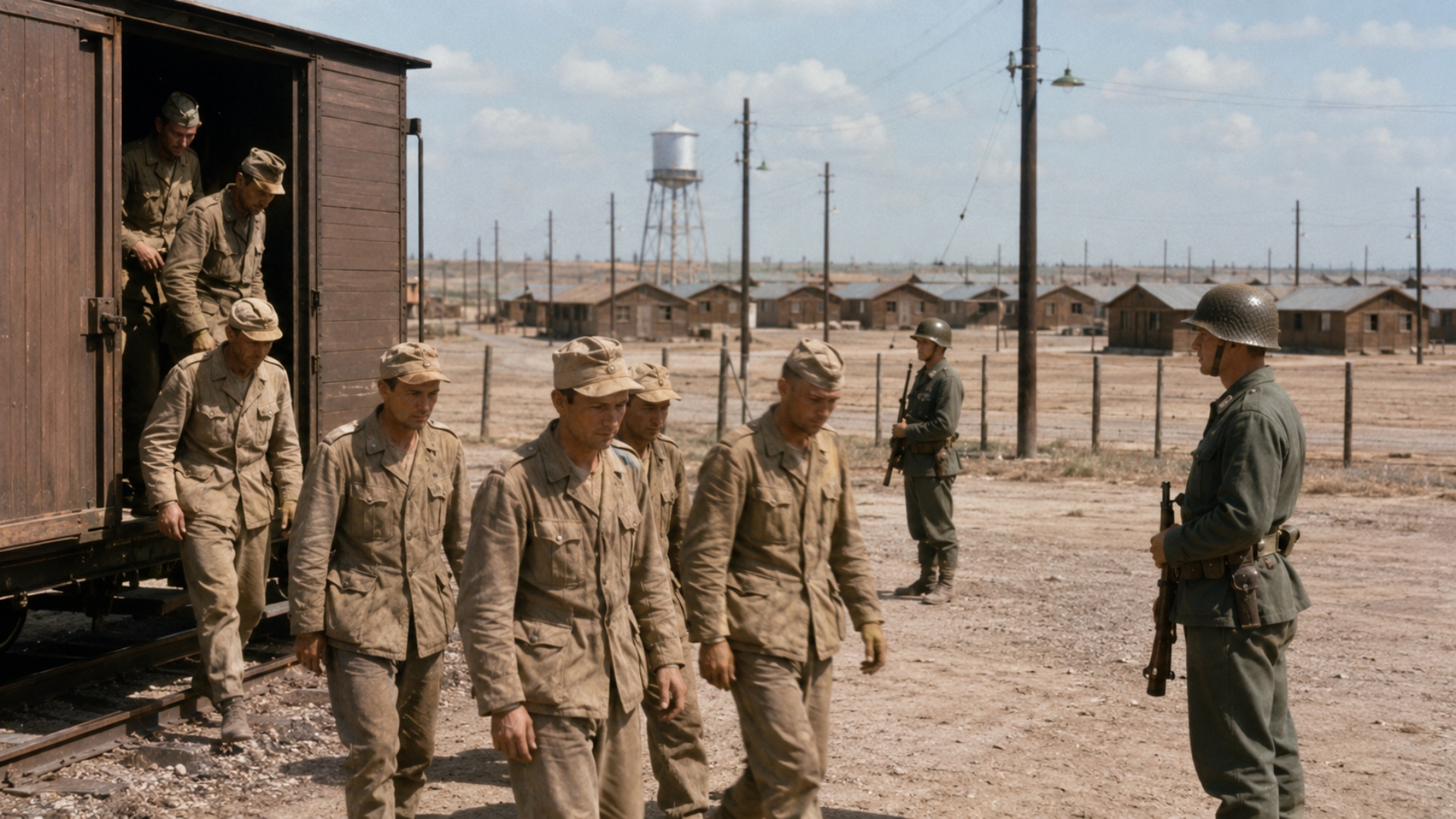
In June 1943, the first German prisoners arrived at Camp Hearne, a prisoner-of-war camp outside Hearne, Texas. Many were noncommissioned officers from the Afrika Korps, captured after the Axis defeat in Tunisia and transported across the Atlantic to the United States. Camp Hearne’s own history records that those first prisoners arrived in June 1943, and that by June 1945 more than 425,000 Axis POWs were held in hundreds of camps across the country.
For many of those men, America was supposed to look broken. Nazi propaganda had described the United States as chaotic, racially divided, decadent, materialistic, and fragile. It portrayed democracy as weakness and diversity as disorder. German soldiers raised under that system had been told that America’s wealth hid moral collapse. Then they arrived. What they saw did not fit the story.
At ports, rail stations, farms, towns, and camps, German prisoners encountered a country operating with unnerving confidence. Civilians moved freely near military installations. Women worked in jobs many German soldiers associated with men. Black and white Americans appeared in the same war economy, even if American segregation and racism remained very real. Food was plentiful. Trains ran. Factories were visible from rail lines. Newspapers criticized leaders openly.
The surprise was not that America was perfect. It was that America functioned so powerfully while allowing so much that Nazi ideology had taught them to despise.
Camp Hearne Looked More Like a Town Than a Dungeon
Camp Hearne was not a concentration camp, and it was not meant to be one. It was a U.S. Army prisoner-of-war facility built under the rules of the Geneva Convention. American planners were expected to provide food, shelter, medical care, mail, recreation, and regulated work opportunities for prisoners. That alone challenged German expectations.
The United States housed German POWs in a vast domestic camp network. The National Archives notes that the wartime POW system held an estimated 425,000 German prisoners in the United States. Texas had especially large numbers because of its available land, climate, and distance from the coasts. Camp Hearne became one of the best-known examples. It included barracks, recreation areas, work spaces, and eventually cultural facilities created by the prisoners themselves. Local and site histories describe theaters, orchestras, soccer, artistic work, gardens, fountains, and organized camp life.
To soldiers who had expected starvation or humiliation, the material conditions could be disorienting. The camp was still a prison. It had fences, guards, rules, restrictions, surveillance, and loss of freedom. But it was also a place where many prisoners encountered a standard of housing, food, medical care, and routine that contrasted sharply with wartime Europe. That contrast was powerful because it did not arrive as a lecture. It arrived as a bed, a meal, an electric light, a medical inspection, a library shelf, and a guard who followed procedure.
The Geneva Convention Became a Weapon of Contrast
The United States had practical reasons for treating POWs according to international law. It wanted reciprocal treatment for captured American soldiers, and it wanted to avoid giving Germany an excuse for retaliation. It also needed prisoner labor under regulated conditions, especially as millions of American men served overseas. But the effect on German prisoners could be ideological.
They were read rules. They received mail privileges. They were inspected by neutral representatives. They had access to medical care. They could complain through channels. Those procedures were not sentimental. They were policy. That mattered because Nazi power had trained people to associate authority with fear. In the American POW system, authority often appeared as paperwork, routine, and regulation. Guards still carried weapons. Prisoners were still confined. But the system’s legitimacy depended on rules rather than arbitrary terror.
For some German POWs, that was difficult to interpret. Was it weakness? Propaganda? A trap? Or was this simply how the United States chose to behave, even toward enemies? The answer was not simple. American treatment of POWs was far better than the treatment many Allied prisoners received in Axis captivity, and incomparably better than the treatment of Soviet POWs held by Nazi Germany. But the United States itself was still segregated, still unequal, and still deeply discriminatory in many parts of daily life. That contradiction made the lesson more complicated.
Race Exposed Both America’s Promise and Its Contradictions
German prisoners also encountered America’s racial reality. This was not a simple story of equality. The United States in the 1940s remained deeply segregated, especially in the South. Black Americans served in a segregated military, faced discrimination in housing, employment, voting, transportation, and public life, and often lived under the threat of racial violence.
German POWs sometimes noticed these contradictions quickly. Some saw that enemy prisoners could receive treatment, food, or recreational opportunities that Black American citizens were denied in nearby towns. That was not a triumph of democracy. It was an indictment of American racism. At the same time, the wartime labor system and military environment exposed POWs to realities Nazi ideology could not easily explain. Black Americans worked in skilled roles. Mexican-American laborers, Black workers, women, and white workers all contributed to the same war economy. German prisoners sometimes received orders from people Nazi ideology had taught them to regard as inferior.
The efficiency of that world mattered. It did not erase American hypocrisy. But it did show that Nazi racial doctrine was not a reliable guide to power, intelligence, organization, or civilization. For a prisoner who had absorbed years of racial propaganda, that could be destabilizing.
Abundance Undermined the Myth of American Weakness
Food made a deep impression. Many German soldiers had experienced shortages, military rations, desert hardship, or the declining conditions of wartime Europe. In the United States, they saw food wasted casually, lunch pails filled, grocery shelves stocked, and farm output on a scale that seemed almost unreal. That abundance was not incidental. It reflected the same structural advantage that made American military production so formidable.
The United States had land, fuel, machinery, railroads, refrigeration, fertilizer, labor systems, and markets capable of feeding both its own population and its armed forces overseas. To prisoners from a Europe of ration cards and scarcity, abundance was political. It showed that American morale did not depend on slogans alone. It rested on material security. Citizens who ate well, traveled freely, read newspapers, listened to radios, and worked in expanding industries were not living in the desperate society Nazi propaganda had described.
That did not mean everyone in America was comfortable. Poverty, racism, labor disputes, and regional inequality remained real. But compared with wartime Germany, the visible scale of American supply was staggering.
Why the POW Experience Mattered After the War
By the end of World War II, the United States had held hundreds of thousands of German prisoners. Many returned to Europe after years of captivity in a country they had been taught to hate and underestimate. Not all changed their beliefs. Some remained committed Nazis. Some resented American reeducation efforts. Some simply wanted to survive and go home. A prison camp, no matter how well run, was still a place of confinement.
But for others, the experience mattered. They had seen the enemy’s society from inside the wire and outside it. They had worked on American farms, read American newspapers, heard American arguments, watched American women work, encountered racial contradictions, and seen a war economy that did not need to hide its strength. That experience complicated everything they had been told.
The United States had not defeated Germany simply because it possessed more weapons. It had defeated Germany because its political, industrial, agricultural, and logistical systems could sustain a global war while still preserving much of ordinary civilian life. For a German POW, that was one of the hardest truths to absorb. The country Nazi propaganda had dismissed as weak had proved strong in ways the dictatorship did not understand.
The Quiet Defeat of an Idea
The story of German POWs in America is not only a story of captivity. It is a story of exposure. The prisoners arrived expecting to see the enemy revealed as corrupt, divided, and exhausted. Instead, many saw a society full of contradictions but still functioning at extraordinary scale. They saw criticism without collapse. Diversity without paralysis. Comfort without military weakness. Rules applied even to enemies.
That did not make America flawless. It made Nazi propaganda less believable. In that sense, Camp Hearne and camps like it became strange battlegrounds of the mind. No shots were fired there. No armies maneuvered across the Texas fields. But ideas were tested every day in the routines of food, work, speech, discipline, and power.
The German prisoners had been told that fear made nations strong. America showed them something more unsettling. A country could argue, improvise, tolerate disorder, expose its factories, feed its enemies, and still win. That was the lesson many had not expected to learn behind barbed wire.

Post a Comment for "How German POWs Reacted to America's Hidden Truth"
Post a Comment