
Guest Essay: Korea's Shame in Revoking Pro-Palestine Activist's Passport
A Day of Solidarity in Barcelona
On April 18, Spanish Prime Minister Pedro Sánchez hosted a summit titled “In Defense of Democracy” in Barcelona. The event brought together several left-leaning leaders, including Mexican President Claudia Sheinbaum, Brazilian President Luiz Inácio Lula da Silva, and Colombian President Gustavo Petro. This gathering highlighted the global conversation around democracy, human rights, and international solidarity.
A week later, on April 24, I arrived in Barcelona to attend a literary event. Although the summit had already concluded, I hoped to stumble upon a related demonstration. My hopes were realized on Sunday, April 26, when I encountered a peaceful march against war while heading to the Picasso Museum.
The first sights that caught my attention were a Lebanese flag, a Palestinian flag, and a large banner hanging from a sound truck that read, “No a la guerra,” or “No to war.” I had worn a T-shirt that said, “Solidarity for Peace in Palestine,” so I was well-prepared for the occasion.
The procession moved from Jaume I Station on the Barcelona Metro to a square called Plaça Sant Jaume. Across from the station, the Catalan trade union building displayed a small banner with the words “No genocidi” between pictures of the Palestinian flag. The sound truck stopped at the plaza, and a middle-aged woman took the microphone. Though I couldn’t understand her Spanish speech, I clearly heard phrases like “no to war” and “no to rearmament.” She also mentioned countries such as Syria, Lebanon, Iran, and Palestine. During pauses, people shouted English slogans like “Free, free Palestine!”
Throughout the event, more people gathered at the square. Demonstrators near the sound truck hung up banners with messages like “No to war,” “No to rearmament,” and “Solidarity with the citizens of Ukraine.” Many carried small banners simply stating “Democracy” or waving flags of Palestine, Iran, and Lebanon.
Numerous women wore stickers that said, “No a la guerra.” I wished to get one for myself but couldn't due to my limited knowledge of Spanish.
One notable aspect of the day’s demonstration was the presence of many middle-aged and elderly women among the organizers and protestors. A group of pensioners showed up in orange vests with an orange banner. From what I could gather, their message was that if the government had enough money to wage war, it could afford to pay a more generous pension—a sentiment I found deeply resonant.
Spain has officially recognized the state of Palestine and allowed it to reopen its embassy in Madrid, where the Spanish king welcomed the Palestinian ambassador. Prime Minister Pedro Sánchez has consistently spoken out against the US’ bombing of Iran and its aggressive war of aggression.
In South Korea, President Lee Jae Myung recently criticized Israel’s actions against Palestinians on social media. When Israel’s Foreign Ministry objected, he responded politely but firmly, stating, “It’s disappointing that Israel won’t take the time to heed the reproach from people around the world.”
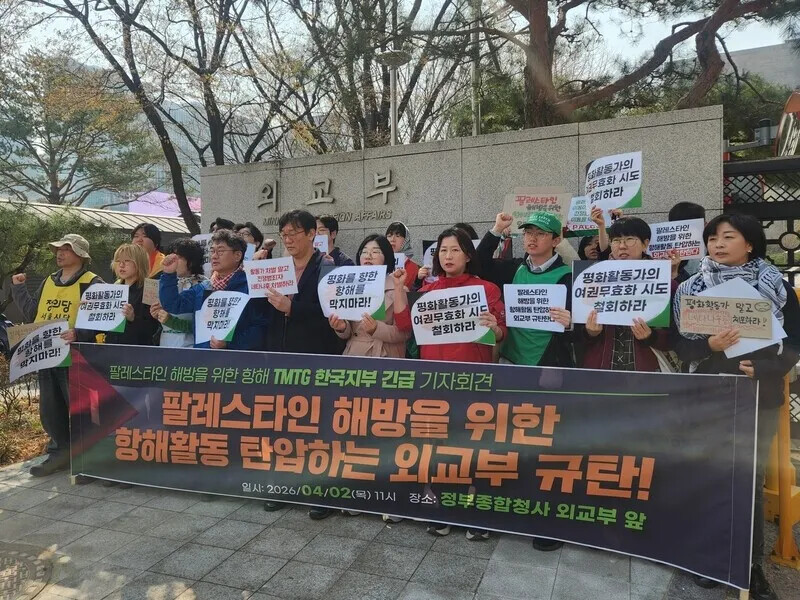
Despite calls for a ceasefire, Israel continues to attack Palestinians in the Gaza Strip. As the area remains under blockade, Korean activist Haecho, a member of the Korean Flotilla for a Free Palestine, set sail aboard a ship in the Freedom Flotilla Coalition to deliver aid to the Palestinian people. However, as soon as she departed, South Korea’s Ministry of Foreign Affairs revoked her passport.
According to Article 12, paragraph 3, of Korea’s Passport Act, the minister of foreign affairs may issue a passport to someone whose passport was denied or revoked if there is a reason prescribed by Presidential Decree, such as urgent humanitarian reasons.
Children are dying in Gaza—starving and being shot by Israeli soldiers. If delivering medicine and relief supplies to these children does not qualify as an urgent humanitarian reason, then what does? Even the president has criticized Israel’s crimes against humanity and violations of international law.
While other countries have reopened Palestinian embassies and refused to let the US use their bases to stage its war of aggression against Iran, South Korea’s Ministry of Foreign Affairs revoked the passport of a human rights activist for trying to deliver lifesaving aid to a people on the brink of death. This is shameful.
If anyone needs to learn how to respect basic human rights, it is South Korea’s Foreign Ministry. “From the river to the sea, Palestine will be free.” If the government of Korea truly upholds the spirit of the provisional government of the Republic of Korea established by the March First Independence Movement, it should reflect deeply on what this slogan truly means.
Please direct questions or comments to [english@hani.co.kr]

Post a Comment for "Guest Essay: Korea's Shame in Revoking Pro-Palestine Activist's Passport"
Post a Comment