
First Hot Subdwarf Binary Unveiled
Discovery of a Unique Binary System
A team of astronomers from around the world has made an important discovery using advanced observational tools. They have identified a binary system known as ZTF J0007+4804, which is the first hot subdwarf-white dwarf system found to produce dwarf nova outbursts. This groundbreaking finding was detailed in a paper published on the arXiv preprint server on May 4.
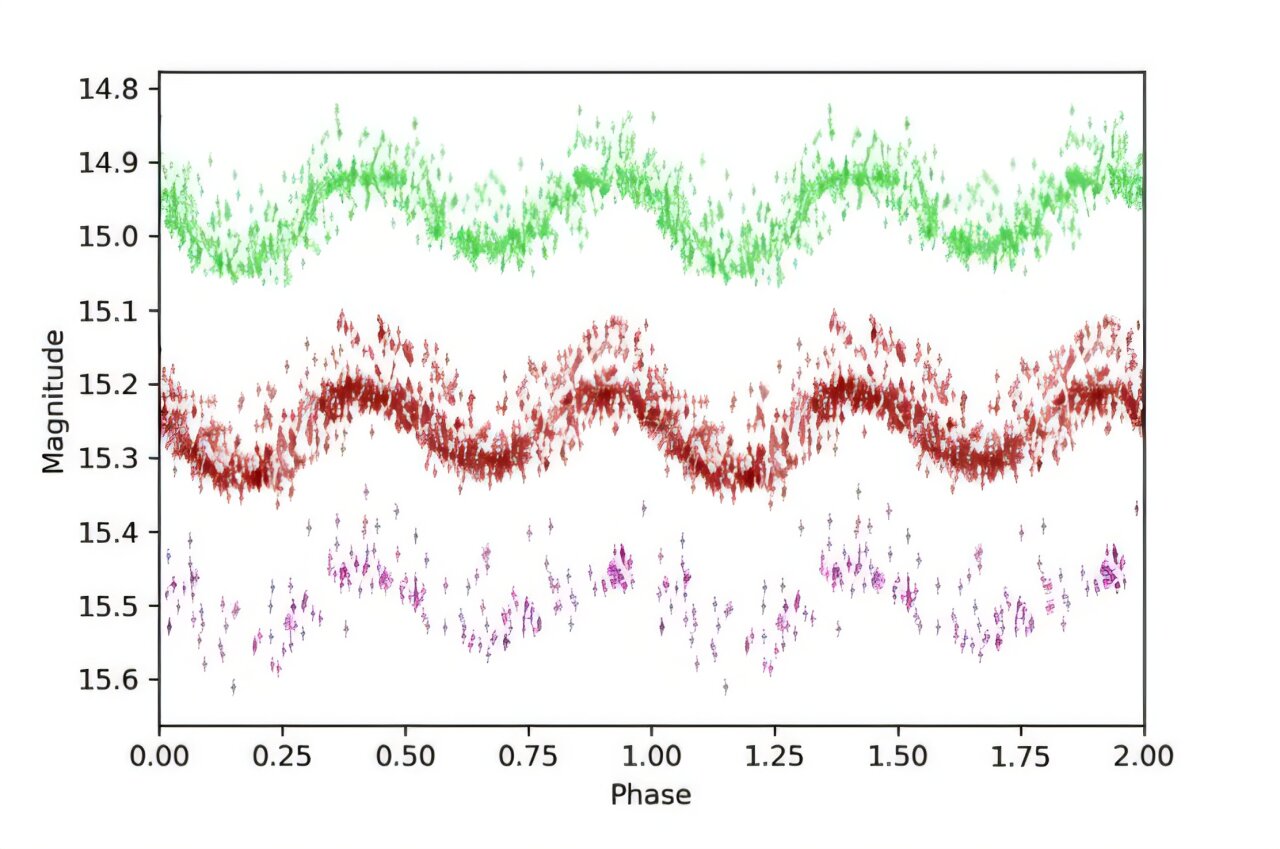
ZTF J0007+4804, officially named ZTF J000742.62+480414.51, was initially reported in 2019 as a subdwarf candidate. By 2022, it was reclassified as an ellipsoidal hot subdwarf-white dwarf (WD) binary candidate with an orbital period of about 1.8 hours. The recent study, led by Eric Stringer of the University of Hamburg in Germany, has provided new insights into this system and confirmed its classification as a hot subdwarf binary.
Observations and Data Collection
The research team used data from the Zwicky Transient Facility (ZTF) and the Transiting Exoplanet Survey Satellite (TESS) to gather information about ZTF J0007+4804. The ZTF observations were conducted in the g, r, and i bands with 30-second exposures, taken between May 2018 and February 2024, resulting in 2,249 data points. Additionally, TESS provided 120-second cadence data for the system, observing it in sectors 17, 57, and 84 between October 2019 and October 2024, yielding 47,104 data points.
The study revealed that ZTF J0007+4804 consists of an accreting white dwarf and a B-type hot subdwarf acting as a donor. The subdwarf has an effective temperature of 23,500 K and a mass of approximately 0.42 solar masses, while the white dwarf is slightly more massive, with an estimated mass of 0.48 solar masses. The orbital period of the system was calculated to be about 1.81 hours.
Dwarf Nova Outbursts and System Dynamics
One of the most significant findings of the study is that ZTF J0007+4804 experiences dwarf nova (DN) outbursts. These outbursts are of the SU UMa-type, characterized by the presence of superoutbursts between regular outbursts. The recurrence time for these outbursts is approximately nine days, with superoutbursts lasting one to two weeks.
The researchers noted that ZTF J0007+4804 is the first known hot subdwarf-WD system exhibiting periodic dwarf nova outbursts. It is also the fourth known subdwarf-WD binary undergoing Roche lobe overflow, which refers to the process where the star fills its Roche lobe and begins transferring mass to its companion.
Future Evolution and Potential Merger
Based on the collected data, the authors estimate that the mass transfer rate of ZTF J0007+4804 is at a level of 1.6 × 10⁻¹¹ solar masses per year. They predict that in about 226 million years, the system will merge due to gravitational wave emission, likely producing a single massive hydrogen-deficient white dwarf. However, they do not rule out the possibility of a thermonuclear explosion scenario.
The scientists concluded that the system likely formed from a main sequence binary with component masses exceeding two solar masses and will eventually merge into a single white dwarf. While a thermonuclear explosion cannot be excluded, the primary outcome is expected to be the formation of a massive white dwarf.
Conclusion
This discovery marks a significant milestone in the study of binary star systems and their evolutionary processes. The unique characteristics of ZTF J0007+4804 provide valuable insights into the dynamics of hot subdwarf-white dwarf binaries and their potential future evolution. As astronomers continue to explore such systems, further discoveries may shed light on the complex interactions that shape the universe.

Post a Comment for "First Hot Subdwarf Binary Unveiled"
Post a Comment