
Billionaires Fueling Trump's China Trip — Why It Matters to You
The Unseen Forces Behind the Trump-Xi Jinping Meeting
When Donald Trump traveled to meet with Xi Jinping, many Americans expected the usual political headlines about tariffs, trade wars, and diplomatic tensions. What surprised people, however, was the number of major corporate executives, banking leaders, and AI power players tied to the visit and surrounding meetings. Suddenly, the trip looked less like a traditional diplomatic mission and more like a gathering of some of the most powerful economic forces on Earth.
And in many ways, that is exactly what it was.
Behind the scenes, the real conversation was not just about politics. It was about artificial intelligence, global supply chains, semiconductor chips, rare earth minerals, banking expansion, manufacturing power, energy security, and the future economic order of the world itself.
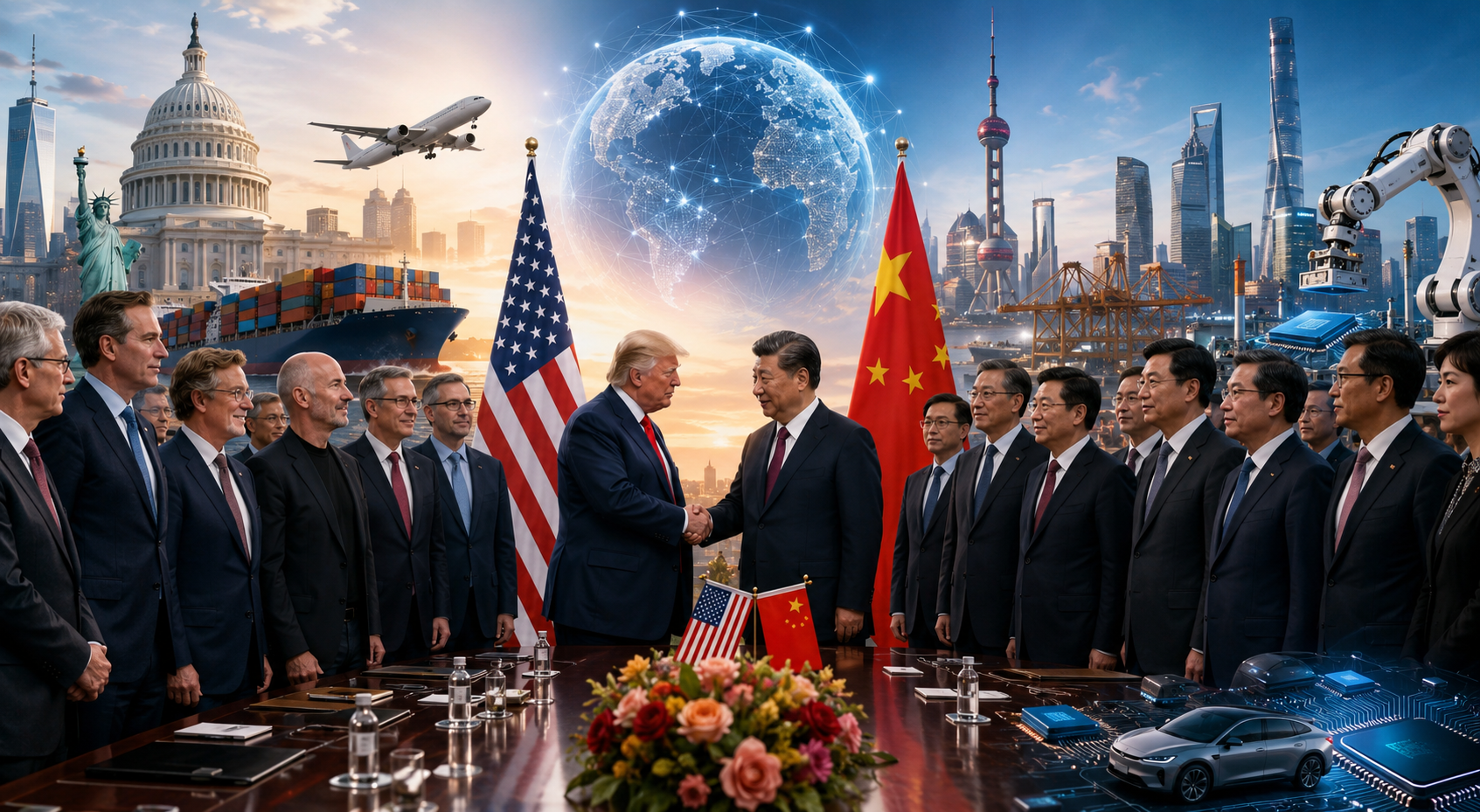
The CEOs and Corporate Titans Connected to the Trip
Among the major business figures and corporations reportedly tied to the China discussions, meetings, or surrounding delegation were top executives:
- Tim Cook of Apple
- Elon Musk of Tesla
- Jensen Huang of NVIDIA
- David Solomon of Goldman Sachs
- Jane Fraser of Citigroup
- Jamie Dimon of JPMorgan Chase
- Larry Fink of BlackRock
Executives tied to Boeing
Representatives connected to Visa and Mastercard
The reason these executives were there is simple but enormously important: America’s largest corporations are still deeply financially connected to China.
The Reality Few Politicians Say Out Loud
For years, Americans have heard political rhetoric about “decoupling” from China. But the reality is far more complicated. Many of the biggest U.S. corporations still rely heavily on China for:
- manufacturing
- factories
- supply chains
- rare earth minerals
- semiconductor production
- battery materials
- AI hardware
- consumer sales
- financial market access
For example, Apple still manufactures large portions of its products inside China. Tesla’s Shanghai Gigafactory remains one of the company’s most important facilities globally. NVIDIA, at the center of the AI boom, has enormous financial interests tied to semiconductor markets and AI infrastructure connected to Asia.
Meanwhile, Wall Street giants like Goldman Sachs, Citigroup, BlackRock, and JPMorgan have long pursued deeper access to Chinese investment markets and financial systems.
Despite public political tension, the U.S. and Chinese economies remain tightly intertwined.
This Was Really About AI
While trade headlines dominated the media coverage, artificial intelligence was arguably the biggest invisible force behind the trip. The AI race between the United States and China is now viewed as one of the defining power struggles of the century.
Why? Because AI is not just about chatbots or social media tools anymore. Whoever dominates advanced AI could influence:
- military systems
- cybersecurity
- robotics
- finance
- automation
- surveillance
- energy systems
- healthcare
- data infrastructure
- global economic productivity
But building AI at scale requires something many people overlook — massive physical infrastructure. That includes:
- semiconductor chips
- data centers
- electricity grids
- cooling systems
- rare earth minerals
- advanced manufacturing
- logistics networks
China still controls enormous portions of those supply chains.
This is why the relationship between the U.S. and China has become so tense, complicated, and economically dangerous. America wants to maintain technological dominance, while China wants to become less dependent on U.S. technology and financial systems.
At the same time, corporations on both sides understand that a complete economic separation could trigger massive disruptions globally.
What Was Actually Accomplished?
Despite the dramatic media coverage, no giant historic agreement was finalized during the visit. However, several important things did happen:
- communication channels reopened
- tensions appeared to cool somewhat
- future trade talks were discussed
- AI competition and restrictions were addressed
- financial cooperation was explored
- energy stability and global conflicts were discussed
- China reportedly signaled possible interest in purchasing more American goods again
For global markets, sometimes avoiding escalation is considered a win by itself.
Why Many Americans Feel Uneasy About It
For ordinary Americans, seeing billionaires, banking executives, and tech leaders standing beside political leaders can create mixed reactions. On one hand, supporters argue these relationships help:
- stabilize markets
- protect jobs
- reduce economic volatility
- keep supply chains functioning
- support American corporations globally
On the other hand, critics increasingly believe globalization primarily benefited corporations and investors while hollowing out parts of the American middle class over the past several decades. For many Americans, this is not just an abstract political argument anymore — it is something they feel in the cost of living, in shrinking economic security, and in the disappearance of the kind of stable middle-class life that once seemed far more attainable.
Beginning in the late 20th century, many corporations aggressively moved manufacturing overseas in search of cheaper labor, lower environmental regulations, fewer worker protections, and higher profit margins. While this strategy helped companies dramatically reduce production costs and increase shareholder returns, entire American industries and communities were transformed in the process. Factory towns that once supported generations of middle-class families saw jobs disappear, wages stagnate, and local economies weaken as manufacturing shifted to countries with lower operating costs, including China.
At the same time, globalization undeniably made many products cheaper and more accessible for consumers. Americans gained access to inexpensive electronics, clothing, furniture, appliances, and technology produced through global supply chains. Large corporations and investors experienced enormous growth as international markets expanded and manufacturing efficiencies skyrocketed.
But critics argue that the financial rewards were distributed unevenly. While corporate profits, executive compensation, and stock market wealth climbed dramatically over the past several decades, many workers saw slower wage growth relative to housing, healthcare, education, childcare, and living expenses. In many parts of the country, people increasingly feel they are working harder simply to maintain a standard of living that previous generations achieved more easily on a single income.
This growing divide helped fuel public distrust toward globalization itself. For many Americans, the promises that free trade and global integration would create widespread prosperity did not fully materialize in their everyday lives. Instead, some communities experienced:
- factory closures
- job outsourcing
- weakened labor bargaining power
- declining small-town economies
- reduced job stability
- rising wealth inequality
- increasing dependence on corporate employers
Critics also point to the concentration of economic power that emerged during this period. As multinational corporations expanded globally, many industries became increasingly consolidated under a smaller number of massive companies with enormous political, technological, and financial influence. Today, a handful of corporations hold tremendous power over areas like technology, banking, media, online commerce, healthcare, food production, and data infrastructure.
Now, artificial intelligence is adding a new layer of anxiety to these existing concerns. Many Americans fear the same economic forces that once automated factories and outsourced manufacturing jobs may now automate white-collar professions, creative industries, administrative work, customer service, logistics, and even parts of healthcare and finance. The fear is not simply that technology will evolve — technology always does — but that the benefits of this next transformation could once again flow disproportionately toward large corporations, investors, and technological elites while ordinary workers absorb the instability.
This is partly why images of billionaire CEOs standing beside political leaders during high-level international negotiations trigger such strong emotional reactions online. To some Americans, the symbolism represents a system where global economic decisions appear increasingly influenced by corporate interests and financial power, while average citizens struggle with inflation, debt, rising housing costs, healthcare expenses, and economic uncertainty.
Whether one fully agrees with that perspective or not, it reflects a growing feeling across the political spectrum that the modern economy often seems designed to reward scale, capital, automation, and global corporate influence more than long-term middle-class stability, local communities, or economic resilience at home.
Now, with AI accelerating rapidly, new fears are emerging that automation and artificial intelligence could concentrate even more wealth and power among large corporations while displacing millions of workers.
The Bigger Story Emerging
This visit was ultimately about far more than politics. It revealed a deeper truth about the modern world: The future global economy is increasingly being shaped by the intersection of governments, AI infrastructure, multinational billion-dollar corporations, data systems, energy networks, and financial power.
The United States and China may publicly compete, but behind closed doors, many of the world’s largest corporations still desperately need cooperation between the two superpowers to protect profits, markets, and technological expansion.
Meanwhile, ordinary people are left trying to navigate rising costs, economic uncertainty, rapid technological disruption, and a future that feels increasingly controlled by forces far larger than themselves.
The trip may not have produced a dramatic breakthrough overnight, but it exposed something many Americans are beginning to realize: The next era of global power may not be shaped solely by politicians and democracy anymore — but by the growing alliance between governments, artificial intelligence, Wall Street, and Big Tech.

Post a Comment for "Billionaires Fueling Trump's China Trip — Why It Matters to You"
Post a Comment